
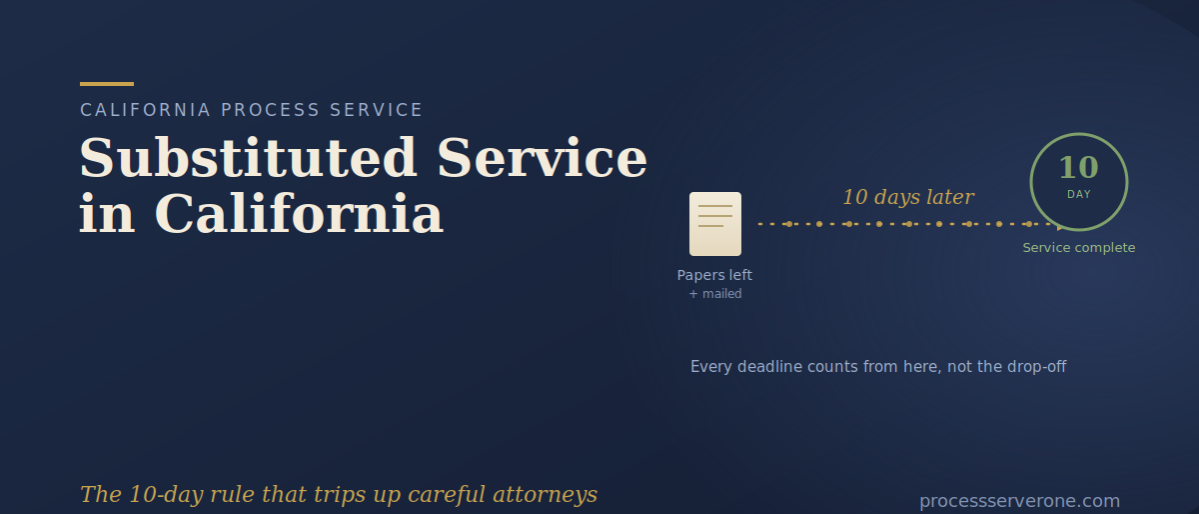
Substituted service in California hides a detail that catches even seasoned attorneys off guard. You picture the job as done the moment the server leaves the papers with someone at the address. Reasonable guess. It is also wrong. Under California law, that drop-off does not complete service. A clock starts instead, and your case deadlines quietly shift with it.
That single quirk, the 10-day rule, changes how you count every deadline that follows. Miss it, and a response window you thought closed is still open. Or a default you filed gets tossed. This guide covers what substituted service is and why the 10-day rule matters so much. It also shows how to make your service hold up when a defendant fights it.
What Substituted Service in California Actually Is
Substituted service in California is the backup plan, so start with the default. Personal service is the gold standard. The server hands the papers directly to the defendant, and service is complete on the spot. But defendants who do not want to be found make that impossible more often than you would think.
Substituted service is the backup. When a server cannot reach the defendant in person, California law offers a path. The server leaves the papers with a competent adult at the home or workplace, then mails a second copy to the same address. Both steps are required. The California Courts self-help guide walks through how substituted service must be carried out. Code of Civil Procedure sections 415.20 through 415.95 govern it. The rule exists so a defendant who dodges personal service cannot stall a case forever. The catch is that it comes with strings, and the biggest one is timing.
The 10-Day Rule: Why Substituted Service in California Is Not “Done” on Drop-Off
Here is the fact that surprises people. With substituted service, the law does not treat service as complete when the papers are left at the address. The law treats service as complete on the 10th day after the follow-up copy goes in the mail.
That gap is not a technicality. Every downstream deadline counts from the date service is complete, not the day the papers dropped. So the defendant’s response window, and everything that flows from it, begins ten days after the drop-off. Count from the wrong date, and the consequences are real. File a default too early, and a court can set it aside. Assume a deadline has passed when it has not, and you may act on a case that is not actually ripe. The 10-day rule is small, but it ripples through the entire timeline.
Why Substituted Service in California Requires Diligence First
You cannot jump straight to substituted service. California requires a genuine attempt at personal service first. Courts take that seriously.
The standard is “reasonable diligence,” and one or two knocks does not clear it. Courts generally expect at least three attempts, on different days and at different times. The server should pick hours when the defendant would likely be home or at work. The server documents each attempt: the date, the time, the location, who answered, and what was said. That record becomes a declaration of due diligence, which attaches to your proof of service. Skip the diligence, and a court can quash your substituted service outright. That sends you back to square one with the clock still running.
Mistakes That Get Substituted Service in California Quashed
The most common error is rushing to substituted service without enough personal attempts. A defendant can file a motion to quash. And thin diligence is the easiest defect to exploit.
Miscounting the 10-day window is another frequent trap. A deadline calculated from the drop-off date, rather than the mailing date, is simply wrong. Address problems cause their own failures. A P.O. box does not qualify as an address for substituted service under California law. Then there is the paperwork gap. The service happened correctly, but the proof of service or diligence declaration is incomplete. And leaving papers with the wrong person can undo the whole effort. It has to be a competent adult in the household or in charge of the office. Each of these can turn a valid-looking serve into a quashed one months down the line.
The Registered-Server Advantage Most People Miss
Here is a payoff that rewards using a professional. Under California Evidence Code section 647, a registered process server’s proof of service carries a presumption of valid service.
In plain terms, the court starts by assuming the service was done correctly. If the defendant wants to challenge it, the burden shifts to them to prove otherwise with real evidence. An unregistered server’s declaration gets no such presumption. That leaves you carrying the burden of proving proper service if it is challenged. For any case where you expect the defendant to fight service, that shift is a genuine advantage. It is one of the quiet reasons a registered process server is worth far more than a willing friend with an envelope.
How Process Server One Helps
This is where experience with California’s rules pays off. Process Server One provides registered process service across California. The team covers all 58 counties with the diligence and documentation these cases demand.
The team makes the personal-service attempts California expects and logs each one with the date, time, and outcome. When substituted service becomes necessary, they complete it correctly. They handle the follow-up mailing, count the 10-day window right, and deliver a proof of service built to withstand a challenge. Because they are registered, that proof carries the Evidence Code 647 presumption in your favor. With more than three decades of experience and same-day, next-day, and weekend options, they keep service on schedule. That holds even when a defendant does everything to avoid it.
None of this guarantees a defendant will be easy to reach, since some people work hard not to be. But it does mean the service itself is done right, documented fully, and ready to hold up.
Why Attorneys Choose Process Server One
Attorneys, law firms, and businesses across California rely on Process Server One for service that survives scrutiny. Not just papers handed off and hoped over. The value is in the details that decide a motion to quash: diligence, timing, and a defensible proof.
That work rests on 30-plus years of experience and registered coverage in every county. It adds careful attempt logs and proofs of service that stand up in court. When your case timeline depends on getting service exactly right, that combination is what keeps everything downstream on track.
Facing a defendant who is dodging service in California? Do not let a miscounted deadline or thin diligence sink your case. Request registered process service now, or call the team at (855) 545-1303. You will talk it through with someone who knows California’s rules cold. Same-day, next-day, and weekend service is available when the clock is against you.
Conclusion
Substituted service in California looks simple and hides a trap. Leaving the papers does not complete service. The 10-day rule does, and every deadline in your case counts from that date. Add the diligence courts demand and the paperwork they scrutinize, and it is clear why so many serves get quashed. The fix is a registered, experienced team. One that documents every attempt and counts the timeline right turns a fragile serve into one that holds.
FAQs
1. When is substituted service complete in California? On the 10th day after the follow-up copy is mailed, not on the day the papers are left at the address.
2. Can I use substituted service right away? No. California requires reasonable diligence at personal service first, usually at least three attempts on different days and times.
3. Why does the 10-day rule matter? Every response deadline counts from the date service is complete, so miscounting it can void a default or leave a case not yet ripe.
4. Does a P.O. box work for substituted service? No. A U.S. Postal Service post office box does not qualify as an address for substituted service under California law.
5. What is the registered-server advantage? Under Evidence Code 647, a registered process server’s proof of service is presumed valid, shifting the burden to the defendant to disprove it.
6. What happens if service is done incorrectly? The defendant can file a motion to quash, which may delay the case, undo a judgment, or force you to serve again.