
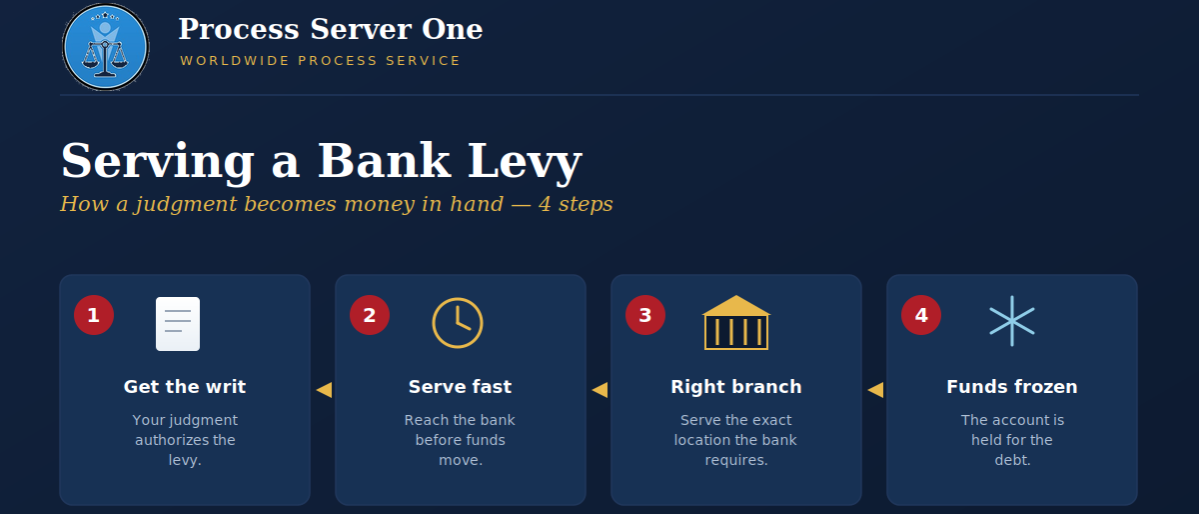
Serving a bank levy is one of the few moments in collections where minutes genuinely matter. You won your judgment. You found the debtor’s account. Now a writ has to reach the bank before the debtor moves the money. Serve too slowly, or serve the wrong location, and the funds are gone by the time the paperwork lands.
That is the whole tension of a bank levy. It is not a leisurely filing, it is a race against a debtor who may be watching their balance. This guide covers what a bank levy is, why timing and the right branch decide the outcome, and how to make sure the serve actually catches the money.
What Serving a Bank Levy Actually Means
A bank levy is a tool judgment creditors use to recover money they are owed. Once you hold a judgment, you can pursue the debtor’s bank funds directly rather than waiting for them to pay.
The mechanics are straightforward on paper. The judgment holder obtains a writ, and a server delivers that writ to the debtor’s account at the institution where it is held. Court self-help centers, like California Courts’ guidance on collecting a judgment, outline how a levy fits into enforcing a judgment. When the bank receives it, the account freezes. The creditor can then apply the funds toward the debt. So the levy is what turns a judgment on paper into actual dollars. The document has no effect until a server properly delivers it to the right financial institution.
Why Timing Is Everything When Serving a Bank Levy
Here is the part that catches creditors off guard. A bank levy only captures the money in the account at the moment a server reaches the bank.
That single fact changes everything. If the debtor withdraws or moves funds before the serve lands, the levy comes up empty. The judgment can be valid and the account real, and it still misses. Debtors who expect a levy often keep balances low or shuffle money between accounts. So speed is not a nice-to-have. It is the difference between collecting and starting over. A same-day levy is worth far more than one that waits in a queue for a week. This is exactly why creditors work with servers who move fast. The account balance is a moving target.
Why the Right Branch Matters So Much
Serving a bank levy fast is only half the battle. A second trap sinks levies that reached the bank promptly but landed in the wrong place. Some banks make enforcement harder by requiring service at a specific branch or a designated central location.
Getting this wrong wastes the very time a levy cannot spare. Serve the corner branch when the bank requires its central legal-service address, and the serve may not stick. That forces a second attempt while the debtor’s balance drains. Large institutions in particular often name one location to receive all legal process. Knowing which address a given bank requires, before the attempt, keeps a prompt serve from failing on a technicality. It is a detail that rewards experience with how each bank handles service.
The Documents Involved in Serving a Bank Levy
A bank levy rarely travels alone. Several documents can be part of the process, and each has a role in freezing and collecting the funds.
The core is the writ of judgment, which authorizes the levy in the first place. Alongside it, a notice of levy tells the bank and the debtor what is happening. A memorandum of costs can capture the added expenses of enforcement. A claim of exemption may enter the picture if the debtor says certain funds are protected. An experienced levy server handles these documents correctly and delivers them to the right party. That way nothing stalls the freeze once it starts.
Common Mistakes When Serving a Bank Levy
Even a valid judgment can fail at the levy stage. Moving too slowly is the classic error. Every day of delay gives the debtor another chance to empty the account.
Serving the wrong branch is another. Large banks especially funnel legal process to a central address. Incomplete or incorrect paperwork causes its own delays. A bank can reject a levy packet that is not in order. Missing account details hurt too. A levy aimed at the wrong account number or institution simply misses. And treating the levy like routine mail, rather than a time-sensitive serve, often lets a collectible judgment slip away. None of these are exotic. They are the details that reward a server who handles levies regularly.
How Process Server One Helps
This is where speed and know-how pay off. Process Server One handles bank levy service with experienced, licensed, and bonded process servers. They move quickly to reach the institution before anyone can tamper with an account.
The team serves the documents a levy requires, including the writ of judgment, memorandum of costs, claim of exemption, and notice of levy. They serve at the location where the account is held, including a specific branch when a bank demands it. And they work within the proper time frame, so the serve holds up. Familiar with local, state, and national laws for bank levies, they help creditors move a judgment toward collection. All of it stays within the rules. And because they operate nationwide, a levy on an out-of-area bank does not slow you down.
None of this guarantees a specific recovery. The balance in an account is never in anyone’s control. But it does mean the serve itself is fast, correct, and delivered where it needs to go.
Why Creditors Choose Process Server One
Attorneys, law firms, and creditors rely on Process Server One for levy service that reaches the bank in time. Not a serve that arrives after the money is gone. The value is in the speed and precision that decide whether a levy catches funds.
That work rests on experienced, licensed, and bonded servers. It adds familiarity with how banks handle legal process, and nationwide coverage for accounts wherever they sit. When a judgment finally gives you leverage, fast and accurate levy service is what turns that leverage into a recovery.
Ready to levy a debtor’s account? Every hour you wait is another hour the debtor can move the money. Submit your bank levy request now, or call the team at (855) 545-1303. You will talk it through with someone who serves levies every day. The sooner the writ reaches the bank, the better your odds of catching the funds.
Conclusion
Serving a bank levy is a race, and the clock rarely favors the patient. A levy only captures what is in the account when a server reaches the bank. And serving the wrong branch can waste the very time you cannot spare. Move fast, serve the right location, and get the paperwork right, and a judgment on paper becomes money in hand. The fix is an experienced, licensed team that handles levies daily. That is what keeps a collectible judgment from slipping through your fingers.
FAQs
1. What is a bank levy? It is a legal tool that lets a judgment creditor collect a debt directly from the debtor’s bank account, once a server delivers a writ to the institution.
2. Why does timing matter so much? A levy only captures the funds in the account at the moment a server reaches the bank. So a delay lets the debtor move the money first.
3. Why does the branch matter? Some banks require service at a specific branch or a designated central location, and serving the wrong place can cause the levy to fail.
4. What documents are involved? Commonly the writ of judgment, notice of levy, memorandum of costs, and a claim of exemption if the debtor asserts protected funds.
5. Can a levy be served nationwide? Yes. A judgment may reach an account at a bank outside your area, which is why nationwide service coverage helps.
6. Does serving a levy guarantee I collect? No. The serve can be fast and correct, but the amount recovered still depends on what is in the account when a server reaches the bank.