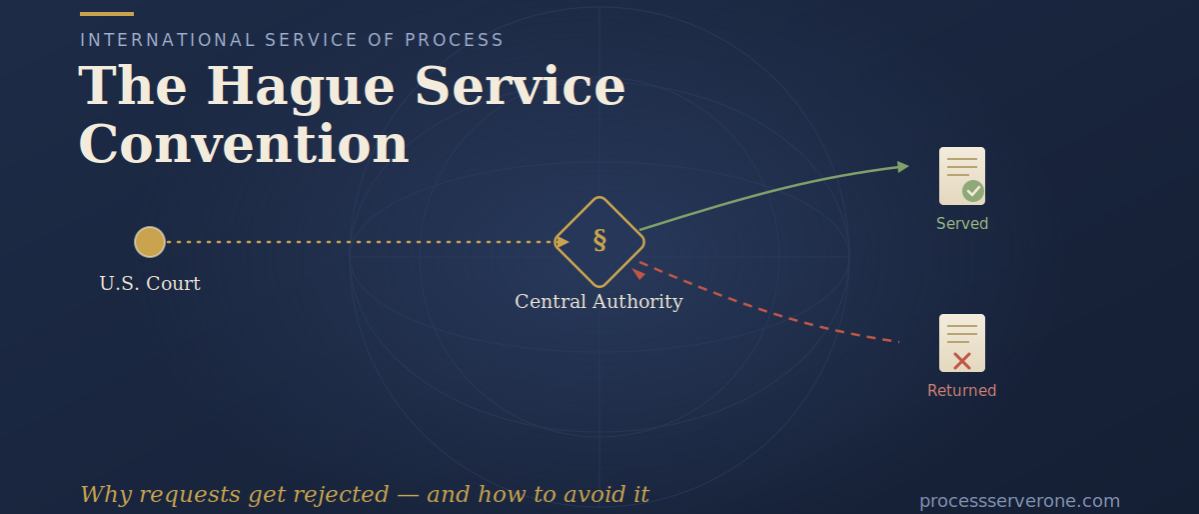
The Hague Service Convention is the treaty that lets you serve a defendant in another country without a diplomat in the room. Your case is in the United States. The person you need to serve lives in Germany, Japan, or India. So instead of guessing at foreign law, you route the request through that country’s Central Authority. The treaty makes it official.
That is the promise. The reality is different. A surprising number of these requests come back rejected, and each one can add two to four months to a case that was already slow. This guide covers how the process works and the errors that get requests bounced. It also shows how to file one that clears the desk on the first pass.
What the Hague Service Convention Actually Does
Signed in 1965, the treaty created a standard, court-recognized way to serve legal documents across borders. As of 2025, more than 80 countries are contracting parties, including Canada, France, Germany, Japan, the United Kingdom, China, and India. The Hague Conference on Private International Law keeps the current member list and each country’s reservations.
Each member country names a Central Authority. That office receives your request, checks it, and coordinates service inside its own borders. You submit the documents. The Central Authority handles delivery under local rules, then returns a certificate confirming service. So the treaty trades speed for certainty. Done right, it produces service a foreign court will actually recognize.
Why the Hague Service Convention Takes So Long
Patience is part of the deal. Most requests run three to six months, and some countries stretch well past that when their Central Authority is swamped.
The path has several stops. Your request reaches the Central Authority, which reviews it. It then passes to a local court, which arranges service and confirms back up the chain. Each handoff takes time. And the Convention sets no hard deadline. So a busy authority can sit on a request for months. That is the baseline even when everything is correct. The real damage comes when something is wrong, because then the clock resets.
The Top Reasons Hague Service Convention Requests Get Rejected
Here is the part most guides skip. A rejection is rarely about the law. It is almost always about the paperwork.
Translation errors top the list. Most countries require documents translated into their official language. The standard is strict. Switzerland, for example, may demand German, French, or Italian, depending on where the recipient lives. A weak or missing translation gets the whole packet returned. Form mistakes come next. The request needs the correct model form, usually the USM-94, filled out in full. A single typo in the defendant’s name can trigger a bounce. So can a missing signature or an incomplete court address. Then there is the reservation trap. Countries can object to specific parts of the treaty. So a method that works in one country is void in another. Assume the rules are uniform, and you file something the destination will not accept.
Why One Rejection Hurts So Much
A rejection is not a quick fix. The packet travels back across the world, you correct it, and you resubmit to the back of the queue.
That round trip routinely adds two to four months. On a case with a discovery cutoff or a statute of limitations in play, those months are not a nuisance. They can decide the outcome. So the goal is never “file and hope.” It is to file something the Central Authority cannot find fault with.
Common Hague Service Convention Challenges
The Hague Service Convention frustrates even careful firms. Confirming a country’s current status and reservations takes research, since the list of members and their objections shifts over time.
Translation is its own project. Finding a certified translator who meets the destination’s exact standard, on a deadline, is harder than it sounds. Tracking matters too, because a request can vanish into a foreign bureaucracy with no update for months. And the paperwork itself is unforgiving. The Central Authority reviews for completeness before anything moves. None of this is beyond reach. It simply rewards knowing each country’s quirks before you file, not after.
How Process Server One Helps
This is where country-specific experience pays off. A team that handles international service of process knows what each Central Authority expects and prepares the request to match.
They confirm the destination’s current status and reservations. They prepare the correct model forms and arrange the certified translations the country requires. When a matter needs a Letter Rogatory instead of the treaty route, an experienced team knows the difference. They handle it. With three decades of international work and a worldwide network, they keep a request moving. You get back a proof of service you can file. When a country’s rules block the standard method, they know the workaround.
None of this controls a Central Authority’s timeline, which is outside anyone’s hands. But it does mean the request leaves your desk correctly, so it is not the one sitting in a rejection pile.
Why Attorneys Choose Process Server One
Attorneys, law firms, and businesses turn to Process Server One for international service that holds up, not just paperwork sent abroad and forgotten. The value is in getting the request right the first time. A single error can add months or void the whole effort.
That work rests on more than 30 years of experience and a global network of servers. It adds in-house translation help and familiarity with each member country’s reservations and quirks. When your case depends on reaching someone across an ocean, that experience is what keeps it moving.
Serving a defendant overseas? Do not let a translation slip or a form error cost you a season. Submit your international service request now, or call the team at (855) 545-1303 to talk it through with a licensed international process server. The sooner a clean request reaches the Central Authority, the sooner your case moves forward.
Conclusion
The Hague Service Convention turned cross-border service from a diplomatic maze into a workable process. But workable is not the same as easy. Requests still get rejected over translations, forms, and country-specific reservations, and every rejection costs months. Knowing each country’s requirements and preparing flawless paperwork matters. So does working with a team that has served there before. Together, they separate a request that clears on the first pass from one that stalls at the border.
FAQs
1. What is the Hague Service Convention? It is a 1965 treaty that creates a standard way to serve legal documents across borders. Requests route through each member country’s Central Authority.
2. How long does service usually take? Most requests take three to six months, though some countries take longer, and errors can add two to four months more.
3. Why do requests get rejected? Most often, due to translation problems, incorrect or incomplete forms, or ignoring a country’s specific reservations to the treaty.
4. Do documents need to be translated? Usually yes. Most countries require translation into their official language, often to a strict, certified standard.
5. What is a Central Authority? The government office each member country designates to receive service requests, review them, and coordinate delivery within its borders.
6. What if a country objects to the standard method? Some countries require a Letter Rogatory or another route instead, which is why country-specific experience matters before you file.