
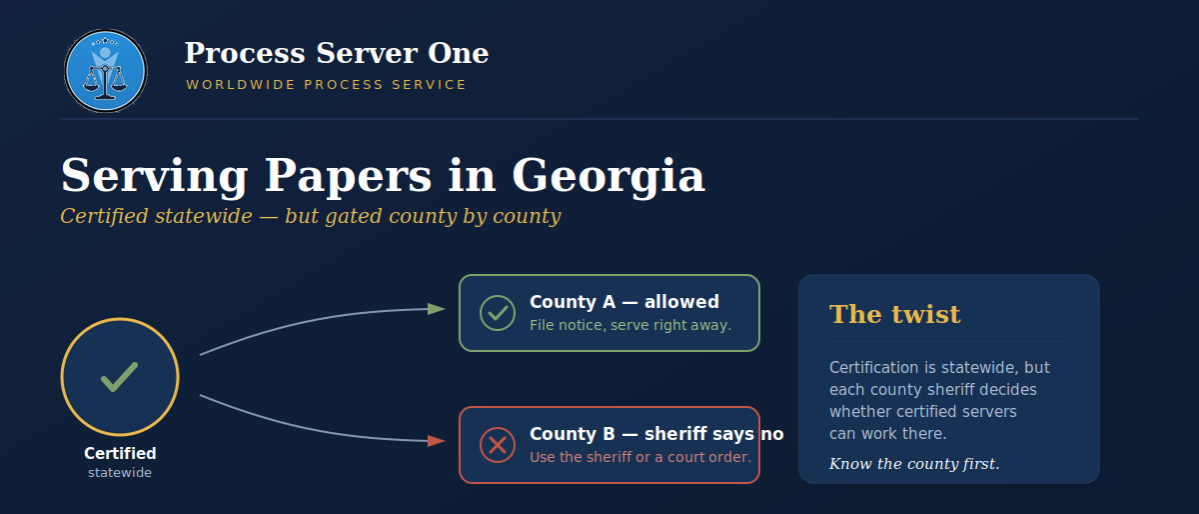
Serving papers in Georgia has a wrinkle that catches out-of-state attorneys off guard. A process server can earn full statewide certification in Georgia. They pass the training, the exam, and the background check, and still get turned away in a given county. The reason lies in a quirk of Georgia law. Each county sheriff decides whether certified private servers can work there at all. So the same server who serves freely in one county may be blocked in the next.
That county-by-county gatekeeping shapes how service actually happens across the state. This guide walks through who can serve and why the county rule matters so much. It also covers what every filer should get right.
Who Can Serve Papers in Georgia
Serving papers in Georgia is limited to a defined group. Georgia is specific about who may hand over legal documents. Under O.C.G.A. § 9-11-4, the law lists who can serve. It is a defined group, not just any willing adult.
The sheriff or a deputy of the county can always serve. So can the marshal of the court. Beyond those officials, the law allows a few more. A citizen specially appointed by the court, a permanent process server named by the court, and, since a 2010 reform, a certified private server. A party to the case can never serve their own papers. That range is wider than in some states. But each route has its own conditions, and the certified-server path is where the county twist lives.
The County-by-County Rule for Serving Papers in Georgia
Here is the part that surprises people. A certificate in Georgia is issued statewide, yet using it is local. Under O.C.G.A. § 9-11-4.1, before a certified server works in any county, they must first file a written notice of intent with that county’s sheriff.
The catch is that the notice only counts if the sheriff allows certified servers in the first place. A sheriff can decline to permit certified private servers in their county. That sends filers back to the sheriff’s office or a court appointment there. The notice also expires after one year. So a server has to refile to keep working in that county. In practical terms, a case that spans several counties can face different rules in each one. Knowing which counties welcome certified servers before an attempt keeps a serve from stalling at the county line.
How Servers Get Certified for Serving Papers in Georgia
Certification is not a rubber stamp. Georgia sets a real bar, which is exactly why courts trust a certified server’s return.
To qualify, an applicant completes a 12-hour approved course on service of process. They also pass a state exam on Georgia service law and clear a fingerprint background check with no disqualifying felony. They also post a surety bond or carry commercial insurance to protect the public against errors. A sheriff reviews the application and grants certification. The server then takes a sworn oath to serve honestly and impartially. The certificate then runs for a set period before renewal. So a certified Georgia process server is someone the system has trained, tested, and put on record. Not just a helper with an envelope.
Why Records Matter When Serving Papers in Georgia
A valid serve is only half the job. The proof of service is what tells the court the serve happened correctly, and Georgia gives it a deadline.
After service, you file the proof with the court. That is an affidavit or the return of service, generally due within five business days. Miss that window, and an otherwise clean serve can face questions. The affidavit should capture the essentials: who was served, where, when, and how. When a defendant challenges service, the case can turn on that record. So accuracy and promptness both count. A detailed, timely proof supports the case. A thin or late one invites a fight over whether service was proper at all.
Common Mistakes When Serving Papers in Georgia
Even careful filers stumble on Georgia’s specifics. Assuming a certified server can work in every county is the classic error. A sheriff who bars certified servers changes the plan entirely.
Letting the county notice lapse is another. That one-year filing has to stay current. Using a party to the case as the server is never allowed. Doing so can void the effort. Missing the five-business-day proof deadline creates its own vulnerability. And a stale address sends any server to the wrong place. That burns time on a case that may already be on the clock. None of these are unusual. They are simply why the work rewards a server who handles Georgia cases every day.
How Process Server One Helps
This is where statewide reach and local knowledge come together. Process Server One provides process service across Georgia with experienced, licensed servers who know the rules county by county.
The team works through the authorized methods in the right order. They file the county notices where certified servers are allowed, and coordinate with the sheriff or a court appointment where they are not. They prepare court-ready affidavits and file the proof within Georgia’s deadline. So a serve holds up. They also use skip-tracing resources to locate evasive and hard-to-find defendants. And because they cover the whole state, a case that reaches from Atlanta to Savannah does not need a second company. With more than three decades of experience, the team handles it all. That runs from summonses and evictions to subpoenas and family law.
None of this makes a dodging defendant easy to reach, since some people work hard to avoid it. But it does mean the service itself is done right, documented fully, and ready to hold up.
Why Attorneys Choose Process Server One
Attorneys, law firms, and businesses across Georgia rely on Process Server One for service that survives scrutiny. Not just papers handed off and hoped over. The value is in the details that decide a challenge: the right server, the right county process, a clean affidavit, and the timing done correctly.
That work rests on more than 30 years of experience and licensed servers. It adds statewide coverage and proofs of service that stand up in court. When your case timeline depends on getting service exactly right, that combination keeps everything downstream on track.
Serving a defendant anywhere in Georgia? Do not let a county rule or a missed deadline sink your case. Request a Georgia process server now, or call the team at (855) 545-1303. You will talk it through with someone who knows the county-by-county rules cold. Same-day and rush service is available when the clock is against you.
Conclusion
Serving papers in Georgia comes with a twist most people miss. Certification is statewide, but using it is local. Each county sheriff decides whether certified servers can work there, so a case that spans counties can face different rules in each. Add the certificate bar, the county notices, and the five-day proof deadline, and it is clear why local knowledge matters so much. Working with an experienced team that knows Georgia county by county turns a patchwork of rules into a smooth, defensible serve.
FAQs
1. Can a certified process server work in any Georgia county? Not automatically. Each county sheriff decides whether to allow certified private servers. A server has to file a notice in each county that permits them.
2. Can I serve my own papers in Georgia? No. A party to the case cannot serve their own documents. Service must go through a sheriff, marshal, a court-appointed person, or a certified server.
3. What does a Georgia certificate require? A 12-hour course, a state exam, a fingerprint background check with no disqualifying felony, and a surety bond or commercial insurance.
4. How often does the county notice need to be filed? The written notice of intent with a county sheriff is effective for one year and must be refiled to keep serving in that county.
5. When does proof of service have to be filed? Generally within five business days of service, so prompt, accurate records matters.
6. What happens if service is done incorrectly? A defendant can challenge it, which may delay the case, undo a judgment, or force you to serve again.