
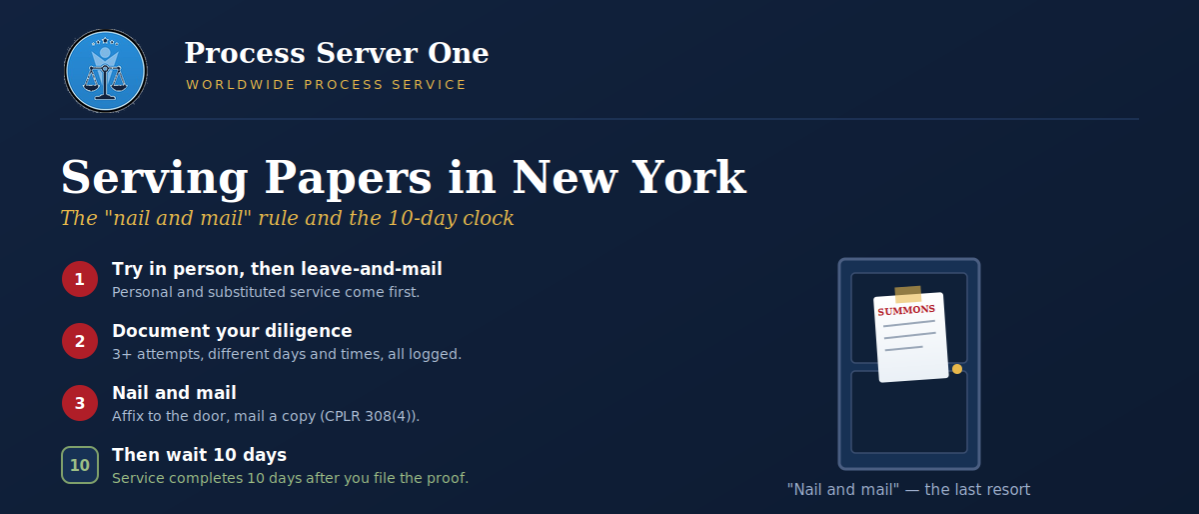
Serving papers in New York can come down to a scene like this: a process server standing outside a Manhattan walk-up, summons in hand, no one answering after three separate visits. In many states, that is a dead end. In New York, it opens a very specific door, literally. The server can tape the summons to that door and mail a copy. New Yorkers call it “nail and mail.” But the rules around it are strict, and one missed step can sink the whole serve.
New York runs one of the most detailed service systems in the country, and the details decide whether a case moves or stalls. This guide walks through how service works here and what nail and mail actually requires. It also covers the timing quirk that catches even experienced filers.
The Order of Methods for Serving Papers in New York
New York does not let you pick whichever service method is easiest. Under CPLR 308, the law lays out methods in a deliberate order, and you have to work down the list.
Personal delivery comes first. The server hands the summons directly to the defendant, and that is the gold standard. If that fails, the next option shifts. You leave the papers with a person of suitable age and discretion at the defendant’s home or workplace, then mail a copy. Only when both of those prove impractical, after genuine effort, can a server move to nail and mail. So the order is not a suggestion. Jumping straight to the last resort is one of the fastest ways to get a serve thrown out.
What “Nail and Mail” Really Means
Nail and mail is New York’s affix-and-mail method under CPLR 308(4). The name is literal. A server affixes the summons to the door of the defendant’s home or business, then mails a second copy to the last known address.
The catch is what has to happen first. A server cannot use this method until reasonable attempts at personal and substituted service have genuinely failed. Courts call that requirement “due diligence,” and they scrutinize it hard. The standard New York approach is at least three attempts, on different days and at different times. Morning, afternoon, and evening, each one documented in detail. Two tries at the same time of day on back-to-back days does not clear the bar. Courts have rejected it. So nail and mail is powerful, but only when the groundwork underneath it is solid.
Why Documentation Decides a New York Serve
Here is where many serves live or die. The process server’s affidavit is what proves service happened correctly. In a nail-and-mail case, it has to show the work.
That affidavit should record a lot. Each attempt with its date and time, evidence the defendant likely lived or worked there, whether the building allowed entry, where exactly the summons went, and the mailing details. New York City adds its own layer. It requires licensed servers to keep a detailed logbook and even describe the hallway and door. When a defendant challenges service, the case can turn on that record. A thin or vague affidavit invites a motion to dismiss for lack of jurisdiction. A detailed one holds up. So the paperwork is not an afterthought. It is the evidence.
The 10-Day Clock in Serving Papers in New York
Serving papers in New York carries a timing quirk that trips up even seasoned litigators. With nail and mail, service is not complete the moment the summons hits the door. It is not complete when the mail goes out, either.
Under CPLR 308(4), service becomes complete 10 days after you file the proof of service with the court. That built-in delay gives the defendant extra time to actually receive papers they might not see right away. It also means the clock on the defendant’s response does not start until that 10-day window closes. Miss this, and you may calculate a deadline from the wrong date. That can mean filing for a default too early or misreading when the case is ripe. There is also a filing deadline for the proof itself. So track the steps carefully from the first attempt.
Who Can Serve Papers in New York, and the NYC License Rule
New York is specific about who may serve, and the rules tighten inside the city. Statewide, a person who is at least 18 and not a party to the case can generally serve papers.
New York City is stricter. A server who serves process five or more times a year must hold a license from the NYC Department of Consumer and Worker Protection. That license comes with real obligations, including the detailed logbook and reporting duties. For anyone handling volume in the five boroughs, using a licensed server is not optional. Choosing a licensed professional from the start avoids a serve a defendant can later attack. It also means the person handling your papers knows the local rules cold.
Common Mistakes When Serving Papers in New York
Even careful filers stumble on New York’s specifics. Rushing to nail and mail without enough documented attempts is the classic error. Thin diligence is the easiest defect for a defendant to exploit.
Affixing to a lobby door instead of the actual apartment door is another common defect. That is true when the apartment door is reachable. Mailing to a stale address the plaintiff knows is wrong undercuts the serve too. Miscounting the 10-day completion window leads to deadline errors. Using an unlicensed server for volume work in NYC creates its own vulnerability. And filing the affidavit late can undo an otherwise valid serve. None of these are unusual. They are simply why the work rewards a server who handles New York cases every day.
How Process Server One Helps
This is where local knowledge pays off. Process Server One provides process service across New York with experienced, licensed servers who follow CPLR 308 to the letter.
The team makes the documented attempts New York expects and logs each one with the date and time. They move through personal, substituted, and nail-and-mail service in the correct order. They prepare court-ready affidavits built to withstand a challenge and handle the NYC licensing requirements. And they use skip-tracing resources to locate evasive and hard-to-find defendants. Because they cover the whole state, one case can span it. A matter that reaches from Manhattan to Buffalo does not need a second company. With more than three decades of experience, the team handles it all. That runs from summonses and evictions to subpoenas and family law.
None of this makes a dodging defendant easy to reach, since some people work hard to avoid it. But it does mean the service itself is done right, documented fully, and ready to hold up.
Why Attorneys Choose Process Server One
Attorneys, law firms, and businesses across New York rely on Process Server One for service that survives scrutiny. Not just papers handed off and hoped over. The value is in the details that decide a motion to dismiss: the right method, real diligence, a clean affidavit, and the timing done correctly.
That work rests on more than 30 years of experience and licensed servers. It adds statewide coverage and proofs of service that stand up in court. When your case timeline depends on getting service exactly right, that combination keeps everything downstream on track.
Serving a defendant in New York City or anywhere in the state? Do not let a rushed serve or a miscounted deadline sink your case. Request a New York process server now, or call the team at (855) 545-1303. You will talk it through with someone who knows CPLR 308 cold. Same-day and rush service is available when the clock is against you.
Conclusion
Serving papers in New York is stricter than it looks. Methods run in a set order. Nail and mail is a last resort that demands documented diligence; the affidavit carries the whole case, and service is not complete until 10 days after you file the proof. Miss any of these, and a clean-looking serve can be challenged months later. Working with an experienced, licensed team that knows CPLR 308 and documents every step turns a fragile serve into one that holds.
FAQs
1. What is “nail and mail” service in New York? It is the affix-and-mail method under CPLR 308(4). A server tapes the summons to the defendant’s door and mails a copy, used only after personal and substituted service fail.
2. How many attempts count as due diligence? Courts typically expect at least three documented attempts on different days and at different times before nail-and-mail is allowed.
3. When is nail-and-mail service complete? Under CPLR 308(4), service is complete 10 days after the proof of service is filed with the court, not when the papers are posted.
4. Do process servers need a license in New York City? Yes. Anyone serving process five or more times a year in NYC must be licensed by the Department of Consumer and Worker Protection.
5. Can a defendant challenge nail-and-mail service? Yes. A defendant can move to dismiss for improper service, which is why detailed affidavits and genuine diligence matter so much.
6. What happens if service is done incorrectly? A defendant can challenge it, which may delay the case, undo a judgment, or force you to serve again.