An out-of-state deposition subpoena feels like a solved problem once you learn the UIDDA. You send your subpoena to the clerk in the witness’s state. The clerk reissues it, and a server delivers it. Simple. Then the deposition falls apart anyway, and you are left wondering what went wrong.
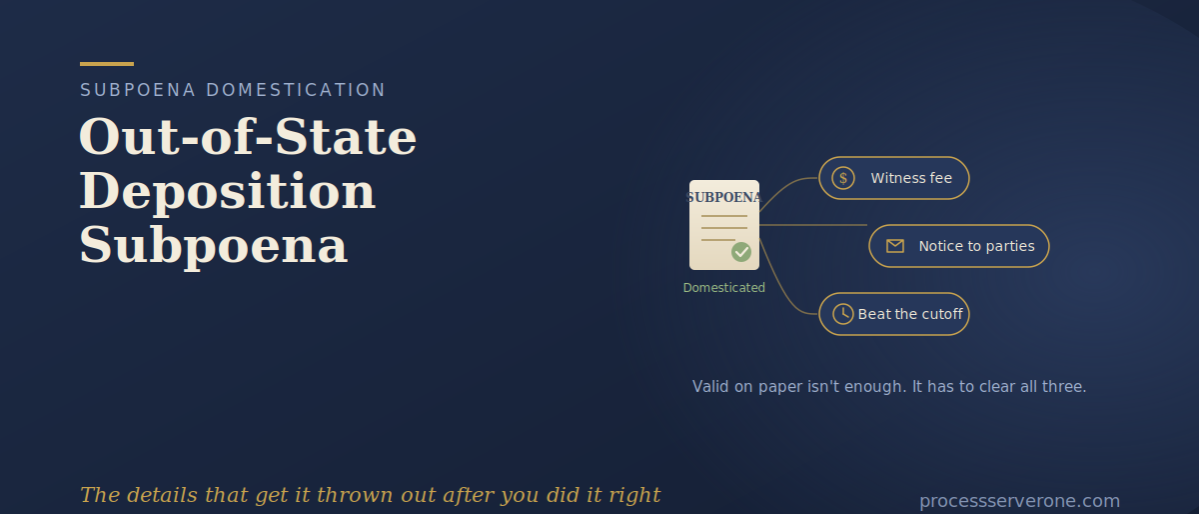
Here is the uncomfortable truth. Domesticating the subpoena is only half the job. A stack of smaller requirements can sink the whole effort. Witness fees, party notices, and timing rules all matter, even when the paperwork was flawless. This guide walks through those traps. They get a subpoena quashed or a witness excused after you thought the hard part was over.
What an Out-of-State Deposition Subpoena Really Involves
Start with the core problem. A subpoena issued by your home court has no power over a witness in another state. It cannot cross the state line on its own authority.
So you domesticate it. Most states use the Uniform Interstate Depositions and Discovery Act, where a clerk in the witness’s state reissues your subpoena as a local one. The Uniform Law Commission tracks which states have adopted the Act. A handful use older routes instead. That might mean the Uniform Foreign Depositions Act, or a non-uniform procedure that needs a commission or a court order. Either way, the reissued subpoena is what actually compels the witness. But compelling a witness takes more than a valid document. That is where attorneys get surprised.
The Witness-Fee Trap in an Out-of-State Deposition Subpoena
Here is a detail that quietly voids more depositions than any filing error. Many states require you to pay the witness a statutory fee, and to pay it at the right moment.
California is a clear example. A non-party deponent is entitled to a witness fee plus mileage. You pay it when the subpoena is served, not later. Skip it, and the witness has a clean reason to ignore the subpoena. The court will likely agree. The amounts are modest, often a set daily fee plus a per-mile rate. But the timing is unforgiving. A subpoena served without the required fee is a subpoena a witness can brush off. So the fee is not an afterthought. It is part of what makes the subpoena enforceable in the first place.
Why the Deposition Notice Matters for Your Subpoena
A second trap catches attorneys who focus only on the witness. You usually have to serve a deposition notice on every party in the case, not just the person being deposed.
This is easy to forget when your attention is fixed on a distant, uncooperative witness. But the other parties have a right to know a deposition is happening. That way they can attend, question the witness, or object. Miss that notice, and opposing counsel gains a ready argument. They can challenge whatever testimony you collect. The fix is simple once you know to do it. Serve the notice on all parties and keep proof that you did. The deposition then stands on firmer ground.
The Timing Trap in an Out-of-State Deposition Subpoena
Now the trap that hurts the most, because it is the hardest to undo. An out-of-state deposition subpoena can take far longer than attorneys expect.
In a UIDDA state, reissuance might take only days. In a non-UIDDA state that needs a commission, a court order, or local counsel, it can stretch two months or more. Meanwhile, your discovery cutoff does not move. If the timeline runs past that cutoff, you may have to ask the court for leave. That means deposing on shortened time or after the deadline, which is never guaranteed. The lesson is to start early. So the moment you know a witness sits out of state, begin the process, because the calendar is working against you from day one.
Mistakes That Sink an Out-of-State Deposition Subpoena
Beyond those big three, a few recurring errors show up again and again. Assuming every state uses the UIDDA is the first. The older UFDA and non-uniform states demand different steps entirely.
Serving under your home state’s rules is another. Service must follow the witness state’s procedure, which usually means in-hand delivery by a sheriff or process server. Filing in the wrong court causes delay too. The subpoena belongs in the specific county where the witness lives or is found. Then there is the friendly-witness assumption. An attorney counts on cooperation that evaporates the week of the deposition. And skipping local requirements invites a rejection. The small fees, forms, and formatting each clerk expects can cost you a fresh cycle of time. None of these are exotic. They are simply the details that reward local knowledge.
How Process Server One Helps
This is where a nationwide team turns a fragile process into a reliable one. A team that handles subpoena domestication and service across all 50 states knows the ground. They know each state’s route, each clerk’s form, and each witness-fee rule.
They confirm whether the destination is a UIDDA, UFDA, or non-uniform state. Then they prepare the reissued subpoena and serve it under local rules, with the required fee attached. They coordinate the party notices and hand-deliver them to the right county clerk when a filing is needed. Then they return a proof of service you can rely on. When a non-UIDDA state calls for local counsel, an experienced team already has those relationships. And they move quickly, because they know your discovery cutoff is not waiting.
None of this controls a court’s own processing time, which varies by state and season. But it does mean every step you can control is handled right the first time.
Why Attorneys Choose Process Server One
Law firms and attorneys nationwide rely on Process Server One for out-of-state discovery that actually produces a witness. Not just a subpoena sent and forgotten. The value is in the details that decide whether testimony holds up: fees, notices, timing, and service done the destination’s way.
That work rests on three decades of experience and coverage in every state. It adds familiarity with UIDDA, UFDA, and the non-uniform holdouts alike. When your case depends on evidence from across a state line, that experience is what keeps it on track.
Need testimony or records from a witness in another state? Do not let a missed fee or a blown cutoff cost you the evidence. Submit your subpoena request now, or call the team at (855) 545-1303. You will talk it through with someone who has handled subpoenas in that state before. The sooner the process starts, the more room you have before your discovery cutoff.
Conclusion
An out-of-state deposition subpoena is not done when the clerk reissues it. It is done when the witness is properly compelled. That means the right fee at service, notice to every party, and enough runway before your discovery cutoff. Those are the details that decide whether you get testimony or excuses. The answer is a team that knows each state’s rules and moves before the calendar closes in. That is what turns a cross-country subpoena into evidence you can use.
FAQs
1. What is an out-of-state deposition subpoena? It is a subpoena used to compel a non-party witness in another state to give testimony or produce records. A clerk reissues it under that state’s rules first.
2. Why can a properly domesticated subpoena still fail? Because domestication is only part of the job. Missing witness fees, party notices, or the discovery cutoff can each sink the deposition.
3. Do I have to pay the witness a fee? Many states require a statutory witness fee plus mileage, often payable at the time of service, or the witness may lawfully ignore the subpoena.
4. Who else needs notice of the deposition? Usually every party in the case, so they can attend, question, or object, which protects the testimony from later challenge.
5. How long does the process take? Anywhere from a few days in a UIDDA state to two months or more where a commission, court order, or local counsel is required.
6. How is the subpoena served? Under the witness state’s rules, which typically means in-hand delivery by a sheriff or a professional process server.