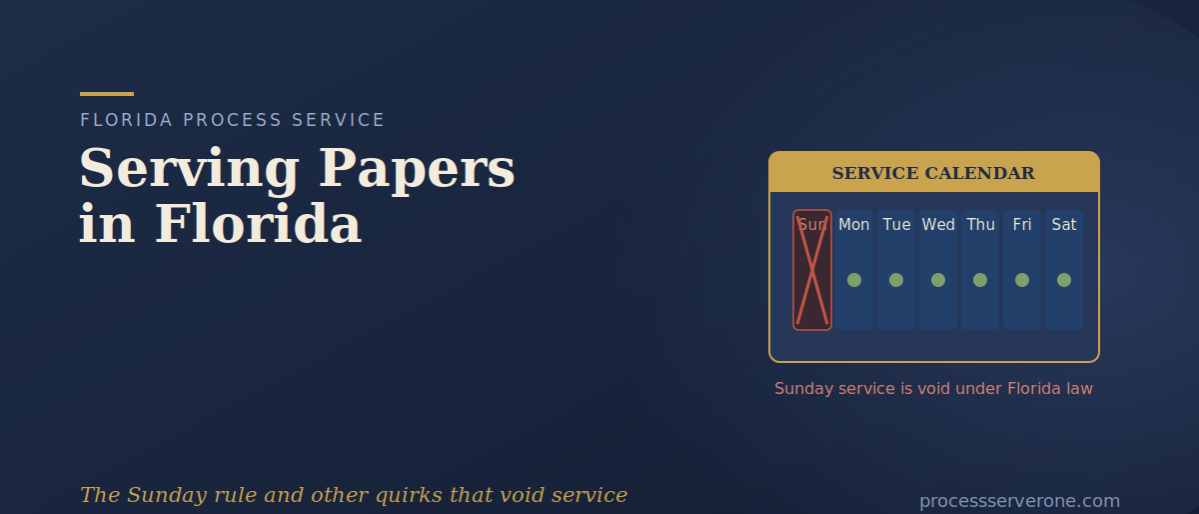
Serving papers in Florida comes with a rule that stops attorneys cold the first time they hear it. Serve a summons on a Sunday, and under Florida law, that service is void. Not delayed, not questionable, void. It is one of several quirks in Florida’s rules. Any of them can quietly undo a service that looked perfectly fine.
Florida takes service more seriously than many states, and the details matter more than most people expect. This guide walks through the rules that trip people up, from the Sunday ban to the certification requirement. The goal is simple: keep a technicality from sinking your case before it starts.
The Rules That Make Serving Papers in Florida Different
Start with the headline quirk. Under Florida Statute 48.20, service of process on a Sunday is void. A service on the wrong day of the week simply does not count. It does not matter how cleanly it went.
Then there is who can serve. Florida does not let just any adult hand over the papers. A party to the case can never serve their own documents. So a landlord cannot serve a tenant, and a plaintiff cannot serve a defendant. Initial process must go through a sheriff, a certified process server, or a court-appointed person. That is stricter than the “any non-party over 18” rule some states allow. It exists to keep service neutral and reliable.
Why Serving Papers in Florida Requires Certification
Here is the part that surprises out-of-state attorneys. Florida runs a formal certification program, and it is not a rubber stamp.
Under Florida Statute 48.27, a process server is certified by the Chief Judge of the judicial circuit. To qualify, a server must be at least 18 and pass a background check with no disqualifying record. They must also complete the required training and post a bond. Certification is renewed each year, and a server can be removed for a false return of service. So a Florida certified process server is someone the court system has vetted, trained, and put on record. Not just a willing helper with an envelope. That accountability is the whole point, and it is why courts trust a certified server’s return.
The Date-and-Time Detail Most People Miss
A small requirement causes an outsized number of problems. Florida law requires the server to mark the exact date and time of service on the process itself.
That endorsement is not a formality. It fixes the precise moment service happened, and many deadlines count from that instant. Leave it off or get it wrong, and you hand a defense attorney an easy opening. A certified server does this automatically. They record it on the first page as the statute requires and capture it in the return of service. It is a tiny step that quietly protects the entire timeline.
How Substitute Service Works When Serving Papers in Florida
Not every serve reaches the defendant in person. When it does not, Florida allows substitute service, but with its own specific conditions.
The server may leave the papers at the defendant’s usual home with a resident who is at least 15 years old. They must explain the contents first. Both parts matter. The recipient has to actually live there. And “usual place of abode” means where the person lives now, not an address they left years ago. Florida courts have thrown out serves left at a former home. So confirming the current residence is essential before any substitute attempt.
Common Mistakes When Serving Papers in Florida
Serving papers in Florida trips up even careful filers on the specifics. Serving on a Sunday is the classic error, since a server unfamiliar with the state may not know the day itself voids the service.
Using the wrong server is another. That could be a party to the case, or someone not certified in the right circuit. Missing the date-and-time endorsement causes its own challenges. So does leaving papers at a stale address that no longer qualifies as the abode. Evasive defendants add a familiar hurdle. And Florida’s snowbird population means a person may split time between states, which makes confirming a current residence trickier than usual. None of these are exotic. They are simply the details that reward a server who works in Florida every day.
How Process Server One Helps
This is where local knowledge pays off. Process Server One provides certified process service across Florida, covering all 67 counties with same-day, next-day, and weekend options.
The team is licensed, bonded, and certified to the circuit’s requirements. So a serve holds up when a defense attorney goes looking for a technicality. They know the Sunday rule, the abode standard, and the date-and-time endorsement cold. They use skip-tracing databases to locate evasive and snowbird defendants. When personal service fails, they complete substitute service correctly and deliver a Proof of Service by email built to withstand scrutiny. With more than three decades of experience, the team handles it all. That runs from small claims and evictions to family law and writs of execution.
None of this guarantees a defendant will be easy to reach, since some people work hard to avoid it. But it does mean the service itself is done right, by someone the court recognizes.
Why Attorneys Choose Process Server One
Attorneys, law firms, and businesses across Florida rely on Process Server One for service that survives scrutiny. Not just papers handed off and hoped over. The value is in the details that decide a motion to quash: the right day, the right server, the right endorsement, and a defensible return.
That work rests on 30-plus years of experience and certified coverage in every circuit. It adds skip tracing for hard-to-find defendants and proofs of service that stand up in court. When your case timeline depends on getting service exactly right, that combination keeps everything downstream on track.
Serving a defendant anywhere in Florida? Do not let a Sunday serve or a stale address sink your case. Request a certified Florida process server now, or call the team at (855) 545-1303. You will talk it through with someone who knows Florida’s rules cold. Same-day, next-day, and weekend service is available when the clock is against you.
Conclusion
Serving papers in Florida is stricter than it looks. A Sunday serve is void, a party cannot serve their own papers, the server must be certified, and the date and time have to be marked on the process. Miss any of these, and a clean-looking serve can be challenged months later. The fix is a certified, experienced team. One that knows Florida’s rules and documents every step turns a fragile serve into one that holds.
FAQs
1. Can papers be served on a Sunday in Florida? No. Under Florida Statute 48.20, service of process on a Sunday is void, so it must happen on another day.
2. Can I serve my own legal papers in Florida? No. A party to the case can never serve their own documents. Initial process must go through a sheriff, a certified process server, or a court-appointed person.
3. Does Florida require a certified process server? Yes. For initial process, Florida requires a sheriff or a server certified by the Chief Judge of the circuit under Florida Statute 48.27.
4. What is the date-and-time rule? Florida requires the server to mark the exact date and time of service on the process, which fixes when service occurred for deadline purposes.
5. How does substitute service work in Florida? The server may leave papers at the defendant’s usual home with a resident who is at least 15, after explaining the contents.
6. What happens if service is done incorrectly? A defendant can file a motion to quash, which may delay the case, undo a judgment, or force you to serve again.