
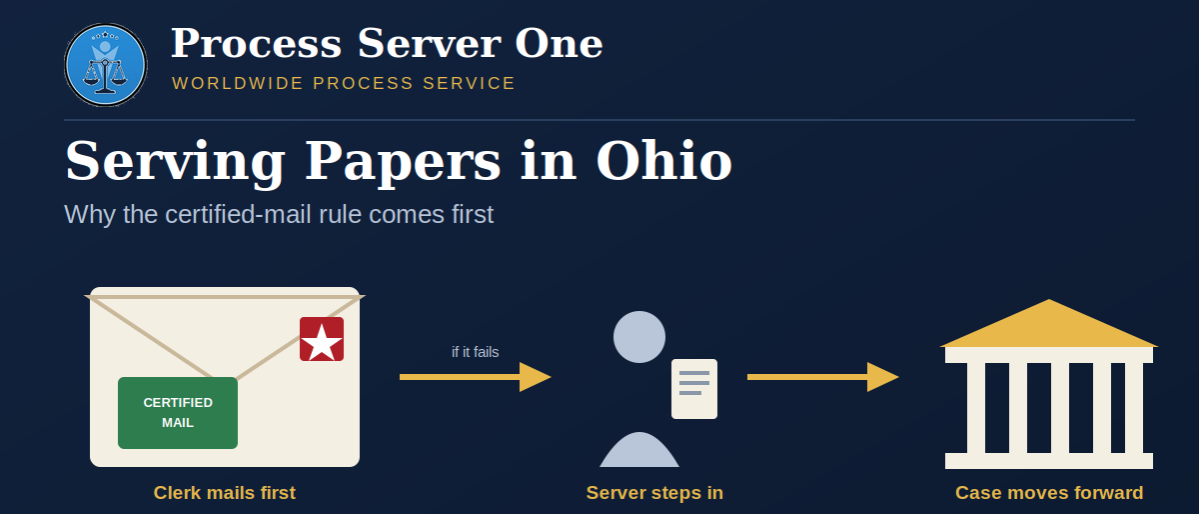
Here is a fact that surprises almost everyone who files a case for the first time. In most Ohio courts, the very first attempt at serving papers in Ohio is not made by a process server at all. The clerk of court makes it, dropping the summons and complaint in the mail as certified mail. No knock on the door. No server on the porch. Just a green card and a signature. That single rule shapes how nearly every Ohio lawsuit begins. It also trips up filers who expect a person to hand-deliver the documents right away.
This guide walks through how the method order works. It covers the deadlines that quietly decide whether a case survives, and the moments when a professional server steps in. It is general background, not legal advice. For anything case-specific, the Ohio Rules of Civil Procedure and qualified counsel remain the right resources.
The Method Order for Serving Papers in Ohio
Serving papers in Ohio follows a sequence, and the order matters. Under Ohio Civil Rule 4.1, the default first method is service by certified mail, which the clerk of court sends to the defendant’s address. When someone signs for that certified mail, service is generally complete, and the case moves forward.
If the certified mail comes back unclaimed or refused, the rule gives the plaintiff other routes. Ordinary mail is one option once certified mail fails, provided the mailing is not returned as undeliverable. Personal service by a court-designated server is another. Residence service is a third, and it leaves the papers with someone of suitable age at the defendant’s home. The point is that Ohio starts with the mail and moves to a live server only when the mail does not do the job.
Why the Certified-Mail Rule Trips People Up
The mail-first approach feels backward to people who assume every lawsuit begins with a dramatic doorstep delivery. It creates a few predictable problems. A defendant who recognizes the sender may simply refuse the certified envelope, and a refused or unclaimed letter buys time nobody planned for.
Addresses go stale, too. If the clerk mails to an old address, the green card never comes back signed, and days slip by while the file sits quiet. Because the clerk handles that first mailing, plaintiffs sometimes assume the whole thing is done and stop paying attention. Nobody is served until someone actually signs. That gap between “mailed” and “served” is where a surprising number of Ohio cases lose their footing.
The Deadlines That Quietly Control a Case
Timing is where serving papers in Ohio gets serious. Under Ohio Civil Rule 3(A), an action does not truly “commence” until the plaintiff serves the defendant within one year of filing the complaint. File on time but miss that one-year window, and a court can treat the case as though it never started.
There is a shorter trap as well. Ohio Civil Rule 4(E) lets a court dismiss a case if service is not made within six months of filing. The plaintiff can avoid that only by showing good cause for the delay. Six months sounds generous until a certified mailing bounces, a new address turns up missing, and a live server has to hit the road. Eviction cases run on an even tighter clock, where the plaintiff generally must serve the tenant a set number of days before the trial date. Miss any of these windows and the remedy is rarely a warning. It is often a dismissal, and refiling costs money and momentum.
Who Can Serve, and the Court-Order Rule
Ohio does not hand a badge to anyone who wants to knock on doors. When certified mail fails and live service is needed, Civil Rule 4.1 is strict about who may serve. The server must be a sheriff, a bailiff, or a person the court appoints to make service. That appointed server generally must be an adult with no stake in the case. The person must also be named in a court order that allows the work.
This is different from states that license process servers as a standing credential. In Ohio, the authority to serve comes case by case through the court’s designation. A seasoned Ohio process server knows how to get that appointment quickly. So the paperwork is ready the moment certified mail falls through, and no time is lost chasing an order after the fact.
Common Mistakes When Serving Papers in Ohio
A handful of errors show up again and again. One is assuming certified mail always works. It often does, but the exceptions are exactly the defendants who are trying to avoid a lawsuit. Another is waiting too long to switch methods, which lets the six-month and one-year clocks eat into the schedule.
A third mistake is skipping the court-order step and sending an unauthorized person to serve, which can void the service entirely. Then there is the sloppy return. A proof of service that is missing dates or a clear account of what happened invites a challenge later. Good notes on every attempt, mailed and personal, are what turn a contested service into a settled one.
How Process Server One Helps With Serving Papers in Ohio
Process Server One works these cases from the certified-mail stage forward. When the clerk’s mailing succeeds, that is the best outcome for everyone. When it comes back unclaimed, the team is ready to move to the next method without losing the days that Ohio’s deadlines punish. That includes confirming a current address before anyone drives out, since serving the wrong door wastes an attempt and the calendar.
The team also handles the court-appointment step when personal or residence service is required. It keeps a detailed record of every attempt for a clean return. And it sends status updates, so an attorney is never left guessing where a service stands. For matters that cross state lines, it coordinates service in and out of Ohio and around the world. That helps when a defendant has moved or a plaintiff is filing from another state. None of this guarantees a signature from someone determined to hide, but it keeps the process professional, documented, and moving.
Why Attorneys Choose Process Server One
Law firms, in-house counsel, landlords, and self-represented filers turn to Process Server One for Ohio service. The team understands the mail-first sequence and the tight windows built around it. Experience with Ohio’s court-appointment rule, address checks, and court-ready records keeps a case from stalling on a technicality. The result is fewer surprises, cleaner returns, and service that holds up when opposing counsel questions it.
Working with people who serve papers in this state every week tends to keep a matter moving toward resolution. It keeps the case off the filing desk for a second try.
Conclusion
Serving papers in Ohio starts in the mailbox, not on the porch, and that single quirk drives everything that follows. Certified mail from the clerk comes first. Live service follows when the mail fails. Strict deadlines under Rules 3(A) and 4(E) then decide whether the case stands. Add the court-appointment requirement for personal service and it becomes clear why professional help pays off. Handle the method order and the calendar correctly the first time, and the rest of the case has room to breathe.
Need service handled correctly from the first mailing? Request an Ohio process server now or call (855) 545-1303 to talk through your matter.
FAQs
1. Does serving papers in Ohio always start with certified mail? In most courts, yes. Ohio Civil Rule 4.1 makes certified mail sent by the clerk the default first method, and live service usually follows only if the mail fails.
2. What happens if the certified mail is refused or unclaimed? The plaintiff can move to ordinary mail, personal service, or residence service through a court-designated server, depending on the situation.
3. How long do I have to serve a defendant in Ohio? A court can dismiss a case if you do not obtain service within six months under Rule 4(E). And the action does not commence unless you serve the defendant within one year under Rule 3(A).
4. Can anyone serve papers in Ohio? No. When personal or residence service is needed, the server must be a sheriff, a bailiff, or a person appointed by the court in that specific case.
5. Why is documentation so important? A clear, dated record of every mailed and personal attempt supports a valid return of service. It also helps the service withstand a later challenge.
6. Does Process Server One handle out-of-state and international defendants? Yes. The team coordinates service beyond Ohio and internationally, which helps when a defendant has moved or the matter crosses borders.