Hague service in Japan surprises attorneys who assume you can just drop a summons in the mail to a defendant in Tokyo and call it served. That assumption used to sit in a legal gray zone. Since December 2018, it is simply wrong. Japan formally closed the mail route under the Hague Convention. A serve sent that way now risks being thrown out.
That shift matters for anyone with a case reaching into Japan. Hague service in Japan runs differently than most people expect. Getting it wrong can cost months or void a judgment. This guide walks through what changed and how service actually works there now. It also covers the one requirement that surprises even experienced lawyers.
What Hague Service in Japan Involves
Japan is a longtime member of the Hague Service Convention. That treaty governs how legal documents cross borders. Like every member, Japan names a Central Authority to receive and carry out service requests. There, that role sits with the Ministry of Foreign Affairs.
The core route is formal service under the treaty. You submit your documents to Japan’s Central Authority. It forwards them for service under Japanese law, then returns a certificate confirming it. That certificate is what a U.S. court relies on as proof. So the treaty gives you a recognized, court-backed path. But it channels everything through one official pipeline rather than letting you improvise.
Why Mail No Longer Works for Hague Service in Japan
Here is the part that trips people up. For decades, Japan had not formally objected to Article 10 of the treaty. That is the part that allows service by mail. That silence left U.S. courts split. Some plaintiffs simply mailed documents and hoped.
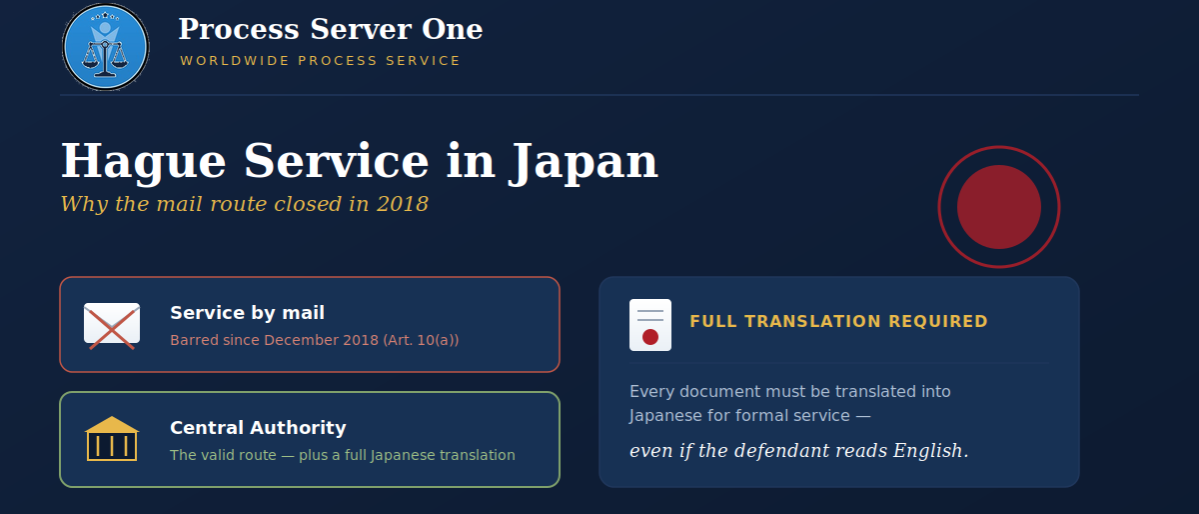
Then, in December 2018, Japan formally objected to Article 10(a). The U.S. State Department’s Japan judicial assistance page confirms that Japan does not permit service through postal channels. In plain terms, direct service by mail on a Japanese defendant is now off the table. A serve attempted by post can be challenged and set aside. That holds even if the papers physically arrive. So the workaround that once felt convenient is now a liability. Under the current rules, service on a defendant in Japan has to go through the Central Authority. Not the mailbox. Skipping that step is one of the fastest ways to undo a case.
The Translation Rule for Hague Service in Japan
A second requirement catches even seasoned attorneys off guard. For formal service through the Central Authority, Japan requires a full Japanese translation of every document served.
The surprising part is what does not excuse it. It does not matter that the defendant reads English perfectly. It does not matter that they already know the contents, or even wrote some of the documents. The translation requirement attaches to the formal service itself. It does not turn on the defendant’s actual understanding. For a complex matter, a patent dispute, say, that can mean a heavy translation of technical material. So the translation is not a courtesy. It is a condition of valid service. Skip it or shortchange it, and the Central Authority can reject the request before service even begins.
Why Hague Service in Japan Takes Patience
Speed is not the treaty’s strength. Formal service through a Central Authority takes time everywhere. Japan is no exception.
The path has several stops. Your request reaches the Central Authority, which reviews it. It then routes the request for service under Japanese procedure and eventually returns the certificate up the chain. Each handoff adds weeks. And the treaty sets no hard deadline. So a request moves at the pace of the process, not your calendar. That reality has a practical lesson attached. If a case is heading toward Japan, start the service process early. A discovery cutoff or a filing deadline will not wait for a foreign authority to act.
Common Mistakes When Serving in Japan
Hague service in Japan trips up even careful lawyers on the specifics. Relying on mail is now the classic error. The 2018 objection quietly reversed years of gray-area practice.
Underestimating the translation is another. That could mean skipping it, using a rough version, or missing part of the packet. Filing incomplete or badly formatted requests invites a bounce from the Central Authority. That costs a full cycle of time. Starting too late is its own trap. The months the process takes leave no room for a rejected first attempt. And assuming a defendant’s English fluency removes the translation duty is a common, costly misreading. None of these are exotic. They are simply why the work rewards someone who has served in Japan before.
How Process Server One Helps
This is where country-specific experience pays off. Process Server One handles international service of process in Japan. The team uses the Hague Convention route and its worldwide network to serve where the rules demand it.
The team prepares the request for Japan’s Central Authority and coordinates the required Japanese translation. They follow the formal process so the serve holds up. When a matter calls for supporting paperwork, court signatures, or an affidavit, they can help assemble it. That can satisfy a judge or extend time. With 33 years of international experience and servers around the world, they treat a Japan assignment as the specialized job it is. Not a routine mailing. And they return a proof of service that you can file with the court.
None of this controls the Central Authority’s own timeline, which is outside anyone’s hands. But it does mean the request leaves correctly, translated, and routed the right way, so it is not the one sitting in a rejection pile.
Why Attorneys Choose Process Server One
Attorneys, law firms, and businesses turn to Process Server One for international service that holds up abroad. Not just papers sent overseas and hoped over. The value is in getting a Japan serve right the first time, when a single misstep can add months or void the effort.
That work rests on 33 years of international experience and a worldwide network of servers. It adds translation coordination and familiarity with the quirks of member countries like Japan. When a case depends on reaching a defendant in Tokyo or Osaka, that experience is what keeps it moving.
Serving a defendant in Japan? Do not let a mailed summons or a missing translation cost you the case. Submit your international service request now, or call the team at (855) 545-1303. You will talk it through with a licensed international process server. The sooner a clean request reaches Japan’s Central Authority, the sooner your case moves forward.
Conclusion
Hague service in Japan runs on a stricter track than most people assume. Since 2018, mail service is barred. Formal requests must go through the Central Authority, and a full Japanese translation is required no matter how well the defendant reads English. Miss any of these, and a serve that looked fine can be undone. Knowing the current rules matters. So does working with a team that has served in Japan before. Together, they turn a slow, high-stakes assignment into one that holds up.
FAQs
1. Can I serve a defendant in Japan by mail? No. Japan formally objected to Article 10(a) in December 2018. So direct mail service is not a valid method. Service must go through the Central Authority.
2. Who is Japan’s Central Authority? The Ministry of Foreign Affairs receives Hague service requests and coordinates service under Japanese law.
3. Do documents need to be translated into Japanese? Yes. Formal service through the Central Authority requires a full Japanese translation of the documents to be served.
4. Does it matter if the defendant reads English? No. The translation requirement applies to the formal service itself, regardless of the defendant’s language ability.
5. How long does Hague service in Japan take? It varies, but formal service through a Central Authority commonly takes several months, so it is wise to start early.
6. What happens if service is done incorrectly? An improper serve, such as one attempted by mail, can be challenged and set aside, which may delay or undo a case.