
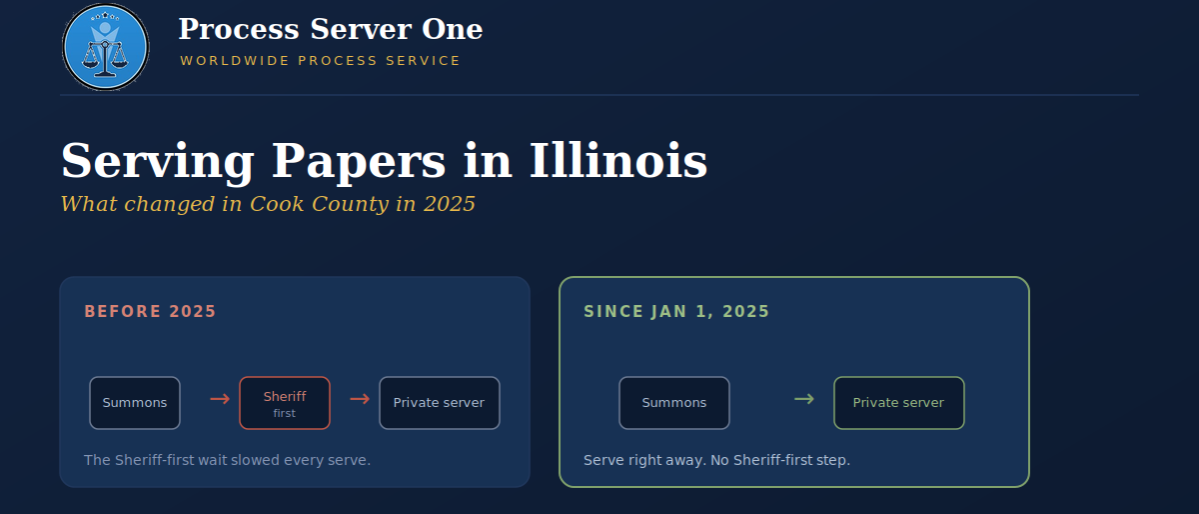
Serving papers in Illinois used to mean one thing in Cook County that it meant nowhere else: a wait. For decades, the county ran on a rule that quietly slowed almost every lawsuit in Chicago. Before a private process server could touch your summons, it had to clear the Cook County Sheriff’s Office first. That meant a queue, a wait, and often a failed attempt before you could even bring in a professional. As of January 1, 2025, that rule is gone.
The change matters for anyone with a case in Illinois, and especially in Chicago. This guide walks through what actually changed and what stayed the same across the state’s 102 counties. It also covers what every filer should still get right.
What Changed for Serving Papers in Illinois
Serving papers in Illinois once split along county lines. The old system singled out Cook County. Because its population tops two million, state law added a hurdle. A summons had to go to the Sheriff before a court could appoint a private server. Filers waited in the Sheriff’s queue. Only after a failed or stalled attempt could they turn to a licensed private detective agency.
Public Act 103-0671 changed that, effective at the start of 2025. Now a licensed private process server can serve a Cook County defendant the moment the summons issues. In most cases, there is no Sheriff-first requirement and no special court appointment. There is one small catch worth knowing. When you use a private server in Cook County, a modest fee still goes to the Sheriff. In plain terms, Cook County now works like the rest of Illinois. You can put a professional on the serve right away.
What Stayed the Same Across Illinois
The headline change was big, but most of Illinois already worked this way. The collar counties never had the Sheriff-first bottleneck. So nothing changed for DuPage, Lake, Kane, Will, or McHenry.
Statewide, the core rules still hold. A party to the case cannot serve their own papers. Service must go through a sheriff, a licensed private detective or agency, or a person the court appoints by order. And the server still has to follow Illinois Supreme Court Rule 102 on how a summons and complaint are served and returned. So the 2025 change removed a Cook County roadblock. It did not loosen the standards that keep a serve valid. Getting those right still decides whether service holds up.
Why Serving Papers in Illinois Still Takes Care
A faster path into Cook County does not make service foolproof. The same challenges that trip up filers everywhere still apply.
Evasive defendants remain a constant. People who do not want to be served will dodge, hide, or stop answering the door. Illinois is also a study in contrasts. A serve in a dense Chicago high-rise poses different problems than one on a downstate rural property. Bad or outdated addresses waste time either way. Deadlines add pressure too. A filing or hearing date does not move just because a service took longer than planned. And the return of service has to be accurate. It is the court’s proof that everything was done correctly. Speed helps, but only when the fundamentals are handled.
Who Can Serve When Serving Papers in Illinois
Illinois is specific about who may serve original process, and getting it wrong is an easy way to lose a serve. The safest route is a licensed, professional server who satisfies the statute automatically.
A sheriff can always serve within the county. A licensed private detective or a registered agency employee can serve as well. That is exactly what the 2025 Cook County change opened up. A private individual can serve only if the court appoints them by order. That adds a step and a delay. Choosing a licensed professional from the start avoids that detour. It also means the person handling your service knows the local rules cold. That is worth far more than saving a few minutes with a willing friend who is not authorized.
Common Mistakes When Serving Papers in Illinois
Even with the new flexibility, filers still stumble on the same points. Assuming the old Cook County process still applies is now one of them. Some people simply have not caught up to the 2025 change.
Using an unauthorized server is another. That could be a party to the case, or an individual who was never appointed. A stale address sends a server to the wrong place and burns days you may not have. Incomplete returns of service invite challenges, because the return is what the court relies on. And treating a serve as routine when a defendant is actively dodging costs you. It usually means missed attempts and lost time. None of these are unusual. They are simply the details that reward working with a server who handles Illinois cases every day.
How Process Server One Helps
This is where statewide experience pays off. Process Server One provides process service across Illinois with licensed and bonded servers. The team covers all 102 counties with same-day, next-day, and weekend options.
The team knows the current rules, including the 2025 Cook County change. So a Chicago serve can start without the old Sheriff-first delay. They use databases to locate defendants and serve them within the law. They handle evasive and hard-to-find recipients, and return a Proof of Service built to withstand a challenge. Because they cover every Illinois county, one case can span the state. A matter that reaches from Chicago to a downstate town does not need a second company. With more than three decades of experience, the team handles it all. That runs from summons and evictions to subpoenas and family law.
None of this makes a dodging defendant easy to reach, since some people work hard to avoid it. But it does mean the service itself is handled correctly, by someone the court recognizes.
Why Attorneys Choose Process Server One
Attorneys, law firms, and businesses across Illinois rely on Process Server One for service that holds up in court. Not just papers handed off and hoped over. The value is in the details that decide a case: the right server, current rules, and a clean return.
That work rests on more than 30 years of experience and licensed, bonded servers. It adds coverage in all 102 counties and proofs of service that stand up in court. When your case timeline depends on getting service right the first time, that combination keeps everything moving.
Have a defendant to serve in Chicago or anywhere in Illinois? The 2025 change means you can start a Cook County serve right away, so do not lose time to the old process. Request an Illinois process server now, or call the team at (855) 545-1303. You will talk it through with someone who knows the current rules cold. Same-day, next-day, and weekend service is available when the clock is against you.
Conclusion
Serving papers in Illinois got easier in 2025, at least in Cook County, where the old Sheriff-first requirement finally fell away. A licensed private server can now start a Chicago serve immediately. But the rules that keep a serve valid- using an authorized server, following Rule 102, and filing a clean return- have not changed. Pairing the new speed with those fundamentals is what matters. An experienced team that covers all 102 counties turns a Chicago case from a waiting game into a fast, defensible serve.
FAQs
1. What changed for serving papers in Cook County in 2025? A licensed private process server can now serve a Cook County defendant without first placing the summons with the Sheriff’s Office. The change took effect January 1, 2025.
2. Do the collar counties follow the same change? The change specifically addressed Cook County. Counties like DuPage, Lake, Kane, Will, and McHenry never had the Sheriff-first requirement.
3. Can I serve my own papers in Illinois? No. A party to the case cannot serve their own documents. Service must go through a sheriff, a licensed server, or a court-appointed person.
4. Who can serve process in Illinois? A sheriff, a licensed private detective or registered agency employee, or a private individual appointed by the court by order.
5. Is there still a fee to the Cook County Sheriff? Yes. When a private server is used in Cook County, a small fee still goes to the Sheriff under the amended statute.
6. What happens if service is done incorrectly? A defendant can challenge it, which may delay the case, undo a judgment, or force you to serve again.