
To serve a subpoena in California for bank or medical records, the custodian is rarely first in line. The person whose records they are comes first. That surprises many attorneys. Picture a subpoena sent straight to a clinic. The custodian reads it, finds no notice to the patient, and sets it aside. Nothing is wrong with the subpoena itself. Still, the clinic has every right to refuse. The records stay put, and the deposition date slips by.
This guide covers the order of operations. It also explains who counts as a consumer, what happens after an objection, and when the step can be skipped. Treat it as background rather than legal advice. For anything specific to a case, a licensed attorney and the court’s own forms are the right resources.
What It Takes to Serve a Subpoena in California in Person
Most subpoenas for a person’s testimony need hand delivery. California’s trial subpoena statute calls for delivery to the witness personally. Leaving a copy with a receptionist does not meet that rule. Substituted service, the kind that works for some summonses, is not part of it. The witness can also demand fees and mileage at the moment of delivery. In that case, the server has to offer them on the spot. Any adult can serve, according to the state’s court help pages. Even so, a trained server brings the right paperwork each time. A records subpoena adds one more layer on top. That layer is the notice.
The Notice Rule Before You Serve a Subpoena in California
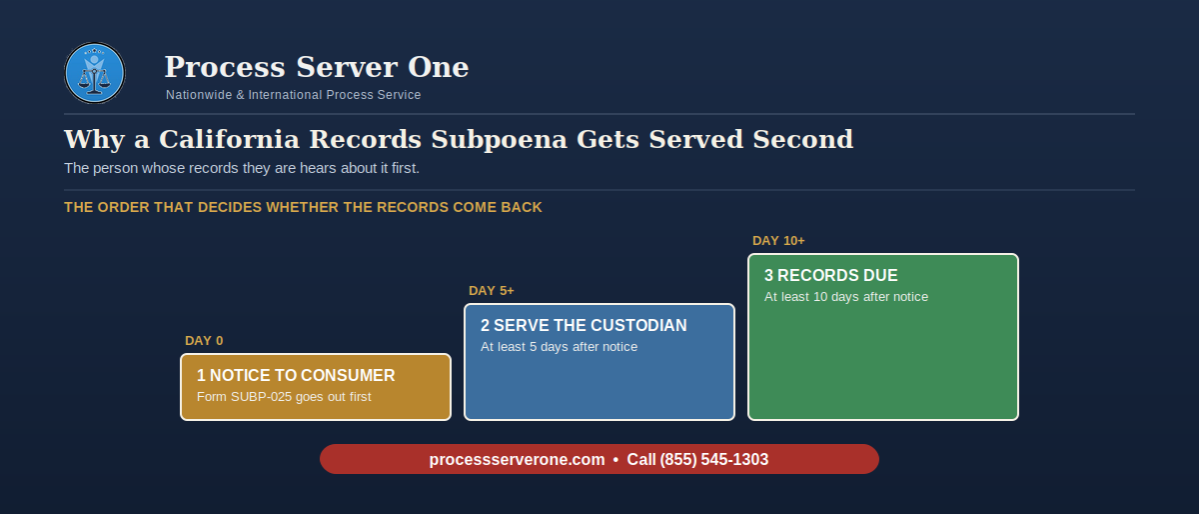
Section 1985.3 of the Code of Civil Procedure protects personal records. It covers records held by banks, doctors, schools, attorneys, accountants, and similar custodians. Before the custodian is served, the person whose records are sought must get notice. That notice goes out on Judicial Council form SUBP-025. It must be served at least five days before the subpoena reaches the custodian. Mail adds extra days. The notice must also arrive at least 10 days before the production date. In short, the order is fixed. Consumer first, custodian second, production last. The California Courts self-help site walks through the form step by step. Skip the first step, and a custodian can refuse to produce anything. The statute backs the custodian up.
Who Counts as a Consumer, and Who Does Not
The statute defines a consumer narrowly. It means an individual, a partnership of five or fewer people, an association, or a trust. A corporation is not on that list. A subpoena for a company’s own records may skip the notice step for that reason. LLCs sit in a gray area, since the statute does not name them. Employment records follow a parallel rule under section 1985.6. That rule covers an employee’s file at an employer. The notice and the timing look much the same. A few cases skip the step entirely. One is a subpoena that does not seek a particular person’s records. Another is a request where the records have no identifying details. And when the serving party is the consumer, and the only subject of the records, notice is not needed.
What Happens After a Consumer Objects
Once notice goes out, the consumer has options. They can send a written objection. They can also file a motion to quash. Either one changes what the custodian does next. Once a custodian learns of either one, it cannot be forced to produce records without a court order. In practice, the records simply wait. The subpoena sits in limbo until a judge rules or the parties agree. Even so, an objection does not end the matter. The court can still order production later. That is why the notice date matters so much. Early notice leaves room for a fight. Late notice leaves none. Put another way, the rule gives the consumer a fair chance to speak first. That is the whole point of the design. It protects privacy without blocking a valid request.
Why Timing Decides How You Serve a Subpoena in California
Count backward from the production date. The consumer notice must land at least 10 days before it. The custodian can be served no sooner than five days after the notice goes out. Add mailing days if the notice goes by mail. Then give the custodian room to work. The state’s self-help guide suggests far more than the minimum, with about 15 days for records. A busy hospital cannot pull years of charts overnight. Rush plans fail for this reason. Same-day service helps when a witness must appear soon. It does not help when records depend on a notice period. Plan the calendar first. Then book the serving.
The Proof of Service Step That Closes the Loop
The notice form has its own proof of service on page two. Whoever delivers or mails the notice completes it and signs it. The subpoena needs its own proof of service too. Keep copies of both. Dates matter most here. A clean paper trail shows that the five-day gap was real. If anyone disputes the order of events later, those dates are the proof. Without them, a judge has only memory to go on. In short, the filing is small, but it carries real weight. It takes a few minutes to finish, and it can save a long argument.
How Process Server One Helps You Serve a Subpoena in California
Process Server One serves subpoenas across all 58 California counties. That includes trial, deposition, record, and personal subpoenas. The team can handle both legs of a records job. One leg is the consumer notice. The other is the custodian subpoena, served on its own tracked schedule. Each delivery gets a proof of service. Rush and same-day options exist when the calendar is tight. Clear dates up front keep the whole schedule honest. The record subpoena page covers the records side in more detail. For a witness who must be handed papers in person, see the page on personal subpoenas.
The Bottom Line
To serve a subpoena in California for personal records, start with the person the records belong to. Send the notice first. Wait out the five days. Then serve the custodian, and leave room before the production date. Most failed records subpoenas do not fail on delivery. They fail on the order. A little planning up front protects the whole deposition schedule.
Need to serve a subpoena in California the right way? Request California subpoena service now or call (855) 545-1303 to talk through your case.
FAQs
1. Can a subpoena be served by mail in California? A subpoena for a witness’s appearance calls for personal delivery. The consumer notice, however, can be mailed. Mailing adds extra days to the deadlines.
2. Who is allowed to deliver a California subpoena? Any adult can serve under the trial subpoena statute. A neutral third party is the safest choice, and the court’s own guide for the consumer notice calls for one.
3. What is a notice to consumer or employee? It is Judicial Council form SUBP-025. It tells the person whose records are sought that a subpoena is coming. That lets them object before anything is produced.
4. Does a corporation get a consumer notice? Not under the statute’s definition. A consumer means an individual, a small partnership, an association, or a trust. Records about a corporation may skip this step.
5. What happens if a consumer objects? The custodian cannot be required to produce the records without a court order. The records wait until a judge rules or the parties agree.
6. Does Process Server One serve subpoenas in California? Yes. The team serves subpoenas in all 58 counties and can handle both the consumer notice and the custodian subpoena.