
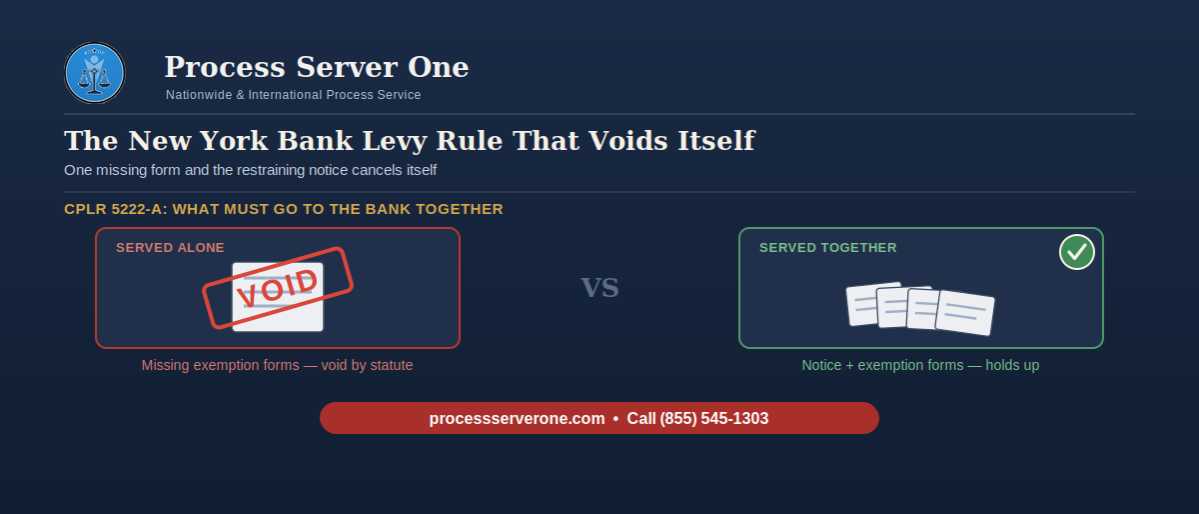
A collections attorney served a bank levy in New York and treated the case as closed. The bank had the restraining notice. The account looked frozen on paper. Yet weeks later, not one dollar had actually moved. The notice had been void from the moment it arrived, because one small packet of paperwork never went with it. New York does not just regulate how a bank levy gets served. It can cancel the levy outright, automatically, the instant a few required documents go missing.
This piece breaks down what has to travel with the restraining notice. It also covers what funds New York protects no matter what. Finally, it walks through the timeline that follows once the bank gets the paperwork. Treat it as background rather than legal advice. For anything specific to a case, the New York CPLR and a licensed attorney are the right resources.
The Rule Behind Every Bank Levy in New York
New York passed the Exempt Income Protection Act in 2009. Lawmakers had two problems in mind. Some creditors used a frozen account as leverage, pushing for a quick settlement whether the funds were exempt or not. Banks also had no efficient way to spot exempt money before freezing it. Direct deposit changed that. Benefits started arriving electronically, and identifying protected funds finally became possible. So CPLR 5222-a built that identification directly into the statute.
The fix is strict on purpose. A bank levy in New York cannot simply freeze first and sort out exemptions later. Instead, the paperwork requirement exists precisely so a debtor’s protected income never gets touched in the first place.
What Has to Go to the Bank With the Restraining Notice
Serve the restraining notice alone, and the levy has already failed. The statute requires a copy of the restraining notice, a separate exemption notice, and two blank exemption claim forms. All of it has to reach the bank together, not in pieces. Leave any one of those out, and the law is explicit about what happens next.
The restraining notice becomes void. The bank cannot legally restrain the account, and it cannot even charge a fee for trying. This is not a technicality a judge can waive on request. It sits directly in the statute’s own text, and courts have enforced it exactly as written, again and again.
What a Bank Levy in New York Cannot Touch
In practice, two protections apply automatically, with no action from the debtor at all. Up to $2,625 in electronically deposited funds is exempt, as long as it arrived within 45 days of the restraint. That threshold covers Social Security, SSI, unemployment, disability, workers’ compensation, pensions, and child support.
A separate wage exemption protects the first $1,920 in an account, treated as income needed for basic living costs. Both figures exist before the debtor files a single form. So a creditor who assumes an entire balance is fair game usually has not read the statute closely enough.
The Clock That Starts the Moment the Bank Gets the Papers
Once the bank receives a compliant restraining notice, the clock starts immediately. The bank has two business days to mail the exemption notice and claim forms to the debtor. From there, the debtor has 20 days from the postmark date to respond. A completed claim form has to reach both the bank and the creditor within that window.
If a claim actually comes in, the bank has to notify the creditor right away. The creditor then gets eight days to object. Should an objection follow, a hearing has to happen within seven days of it. A judge then has five business days after that hearing to decide. Nothing resolved by day 21? The bank has to release the funds back to the debtor regardless of where things stand.
That timeline rewards attorneys who plan around it rather than fight it. A creditor who objects reflexively, without a real basis, is racing a clock that already favors the debtor by design.
What Happens When a Bank Levy in New York Goes Wrong
Courts have not been shy about enforcing this framework. In LR Credit 21 LLC v. Burnett, a creditor seeking a turnover order had to prove it actually complied with CPLR 5222-a. That included proof the bank had served the debtor in the first place. In North Shore University Hospital v. Citibank, a creditor could not even start a turnover proceeding before the debtor’s exemption window had closed.
Midland Funding LLC v. Roberts went further still: a debtor’s exemption claim form alone counts as evidence the funds are exempt. From that point, the creditor carries the burden of disproving it, not the other way around. Object in bad faith, and the risk runs the other way. A creditor can end up paying the debtor’s costs, attorney’s fees, actual damages, and a penalty of up to $1,000.
One more case worth knowing: in Cruz v. TD Bank, the court made clear that a debtor cannot sue the bank directly over an EIPA violation. Relief runs through the CPLR’s own procedures instead, aimed at the creditor’s compliance, not the bank’s conduct.
How Process Server One Handles a Bank Levy in New York
Process Server One treats this paperwork as part of the job, not an afterthought. As a bank levy process server, the team delivers the restraining notice alongside the exemption notice, and both claim forms together, exactly the way the statute requires. That is what keeps a levy from voiding itself before it ever reaches a bank’s compliance desk.
The team is licensed and bonded across all 62 New York counties. Same-day and rush options are available whenever a case cannot wait. Every attempt gets documented in detail. As a result, proof of service goes out fast, and counsel is never left guessing where an account restraint actually stands.
The Bottom Line
Getting this type of levy right in New York comes down to paperwork most people never think to double-check. Skip the exemption notice or either claim form, and the notice is void before it does anything at all. Get that packet right, understand what the law protects automatically, and track the clock that follows. Handle those three things, and the levy actually has a chance of holding up.
Need a bank levy in New York served the way the statute actually requires? Request a New York process server now or call (855) 545-1303 to talk through your case.
FAQs
1. What has to be served with a restraining notice on a New York bank? A copy of the restraining notice, a separate exemption notice, and two blank exemption claim forms. All of it has to go to the bank together, not in separate mailings.
2. What happens if the exemption paperwork is missing? The restraining notice becomes void by statute. The bank cannot legally restrain the account, and it cannot charge a fee for attempting to.
3. How much money does New York protect automatically from a levy like this? Up to $2,625 in recent electronic deposits, covering benefits like Social Security and unemployment, plus a separate $1,920 wage exemption. Both apply before the debtor files anything.
4. How long does a debtor have to claim an exemption? Twenty days from the postmark date on the notice the bank mails out. That notice itself has to go out within two business days of the bank receiving the paperwork.
5. Can a creditor be penalized for objecting to a valid exemption claim? Yes. A bad-faith objection can cost the creditor real money: the debtor’s costs, attorney’s fees, actual damages, and a penalty up to $1,000.
6. Does Process Server One handle bank levies across New York? Yes. The team is licensed and bonded in all 62 counties. Same-day and rush options are available for cases where timing matters most.