Hague service in Germany survives almost every punitive damages claim that reaches it. That surprises most attorneys. One litigator delayed filing for months. She was convinced a German court would reject her complaint the moment it saw those two words. She looked for other options first. Then she drafted a backup plan. A flat refusal seemed certain. Even so, when the request finally went in, the German court served it without comment. That claim was never the real obstacle. A narrower rule mattered instead. It only touches one specific kind of punitive claim. Most lawsuits never come near it at all.
This piece breaks down what German courts do with a punitive claim. It also covers the one variation that changes the outcome. It also covers what a completed request still leaves open later. Treat it as background rather than legal advice. For anything specific to a case, the Hague Service Convention and a licensed attorney are the right resources.
Why Most Punitive Damages Claims Clear Hague Service in Germany
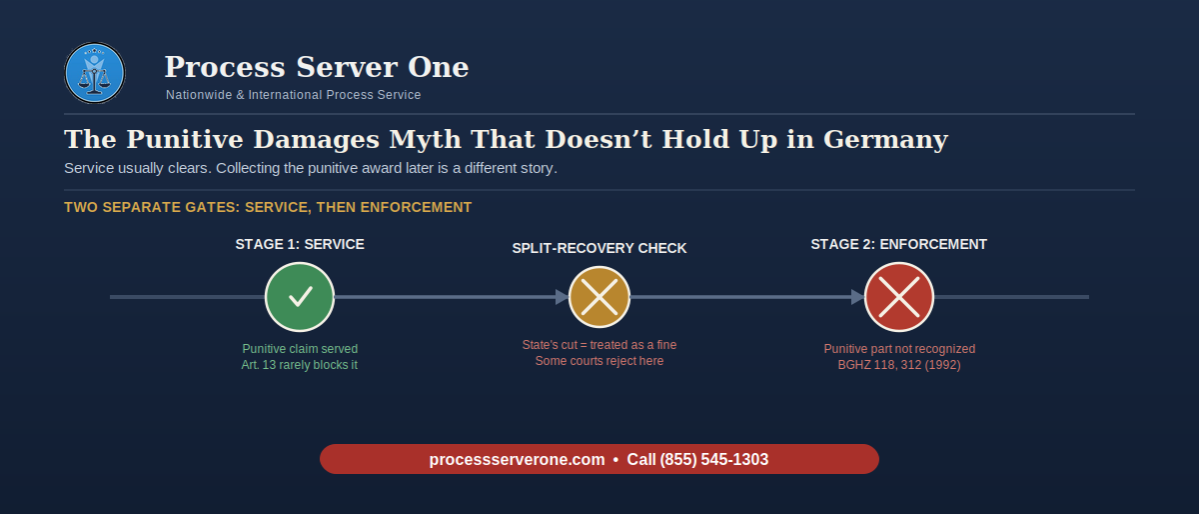
The Hague Service Convention lets Germany refuse a request for one real reason. That reason is Article 13. It applies only when service would threaten German sovereignty or security. Two rulings settled how far that reason reaches. In 2007, Germany’s Federal Constitutional Court let service proceed. Specifically, the case involved U.S. class actions against a German carmaker. The claims sought punitive damages, and the court served them anyway. In 2013, the same court reached the same result for a smaller company facing one such claim. Neither ruling treated that kind of request as a threat to sovereignty by itself. After all, lawsuit risk is simply a cost of doing business across borders, the court said. In short, normal hardship does not clear Article 13’s bar. It never has. The bar stays high.
The One Punitive Damages Claim That Blocks Hague Service in Germany
Split-recovery statutes are the real exception. Georgia’s punitive damages law sends part of certain awards straight to the state treasury. The plaintiff never sees that share. A handful of other states run similar rules. Sometimes part of an award benefits a state, not a private party. Then something shifts. Some German regional courts stop treating the claim as civil at all. They read the state’s cut as closer to a fine than a remedy. The treaty only covers civil or commercial matters. A fine payable to a state sits outside that scope. In practice, that reading alone has been enough for some German courts to reject a request outright. Waiving the state’s share before filing often clears the path. In short, it is a small fix for a real problem. Simply put, nothing more, nothing less.
Why Germany’s Central Authority Isn’t One Office
Germany handles this its own way. Most Hague countries do not. There is no single national office to send a request to. Each local court handles requests for its own area only. That court is tied to wherever the defendant lives or does business. Send a request to the wrong local office. Weeks disappear before anyone notices. Translation adds another layer of risk. Germany’s declaration under Article 5 requires each document in German. A missing translation gets a request rejected outright, no exceptions. There is no way around it. Article 10’s alternatives are not available here either. No mail service. No private server acting alone. It objected to all of it years ago. That leaves the formal channel as the only way in. Still, plan for two to four months from filing to a returned proof of service. Some local dockets run slower yet.
What a Completed Hague Service in Germany Still Leaves Open
Winning service is not the same as winning collection. Germany’s Federal Court of Justice settled that question back in 1992. The case is known as BGHZ 118, 312. The court refused to recognize the punitive part of a U.S. judgment. That refusal applied once the judgment reached Germany for enforcement. German civil law treats damages as compensation, not punishment. A punitive award crosses that line by design. Even so, compensatory damages in the same judgment still collect normally. That part almost never does, no matter how cleanly service went years before. A plaintiff who expects to collect there needs a separate plan for that gap. A smooth service stage does not carry over to enforcement. It never did.
When Waiving the Punitive Claim Actually Helps
None of this makes punitive claims hopeless in Germany. Most are not, and the 2007 and 2013 rulings prove that plainly. The waiver question only matters for split-recovery relief. Drop just the state’s share, and keep the rest of the claim intact. That combination often satisfies a wary regional court. In fact, attorneys outside a split-recovery state can usually skip this step. Either way, enforcement is a separate calculation from service. The two should never get confused. A defendant with real, reachable assets outside Germany changes the math. In practice, that alone can make the enforcement gap beside the point. It often does.
How Process Server One Handles Hague Service in Germany
Process Server One routes each German request to the correct regional court the first time. That routing depends on exactly where the defendant is located. The team prepares the required German translation before anything gets submitted. A small mistake should never stall a case that did not need to stall. The team also flags split-recovery risk early, when a simple waiver could save months of back-and-forth. Every filing gets tracked closely until proof of service comes back signed. Apostille work gets handled too, along with skip tracing whenever a German address needs confirming first. Nothing gets left to chance. For cases stretching beyond Germany, the same team coordinates service across the rest of the world. That work draws on the same experience built up across dozens of Hague countries.
The Bottom Line
Hague service in Germany rarely stops for a normal punitive claim, whatever attorneys assume going in. Split-recovery relief is the real exception, not punitive damages generally. Route the request to the correct regional court. Translate everything into German. Expect two to four months either way. Winning service still is not winning enforcement. That gap belongs to a separate rule, one German courts settled back in 1992.
Need Hague service in Germany handled right from the start? Request German process service now or call (855) 545-1303 to talk through your case.
FAQs
1. Does a punitive damages claim block service in Germany? Almost never. German courts ruled in 2007 and 2013 that a punitive claim, by itself, does not threaten German sovereignty under Article 13.
2. What kind of punitive damages claim gets rejected? A split-recovery claim, where part of the award goes to the state rather than the plaintiff. Some German regional courts treat that share as a fine, not a civil remedy.
3. Is Germany’s Central Authority a single office? No. Requests go to the regional court tied to where the defendant is located, not to one national office.
4. Do documents need to be translated into German? Yes. Germany’s declaration under Article 5 requires German translation for every document, and a missing translation gets a request rejected.
5. Will a German court enforce a U.S. punitive damages judgment later? Not usually. Germany’s Federal Court of Justice ruled on this back in 1992. The punitive part of a foreign judgment violates German public policy, even after service went smoothly.
6. Does Process Server One handle Hague service in Germany? Yes. The team prepares translations and routes requests to the correct regional court. It also flags split-recovery risk before a request gets filed.