
Hague service in Singapore used to be beside the point, because Singapore was never a Hague member at all. A litigator once had a case there. She served it the same way her firm always had. A private server walked up and handed them over. No government office got involved. For years, it just worked, plain and simple. This time, opposing counsel objected. The old shortcut no longer counted as valid service at all. One fact changed the whole case.
This piece covers what changed. It covers why joining made things stricter rather than easier, and what actually has to happen now. Treat it as background rather than legal advice. For anything specific to a case, the Hague Service Convention and a licensed attorney are the right resources.
The Day Hague Service in Singapore Became Mandatory
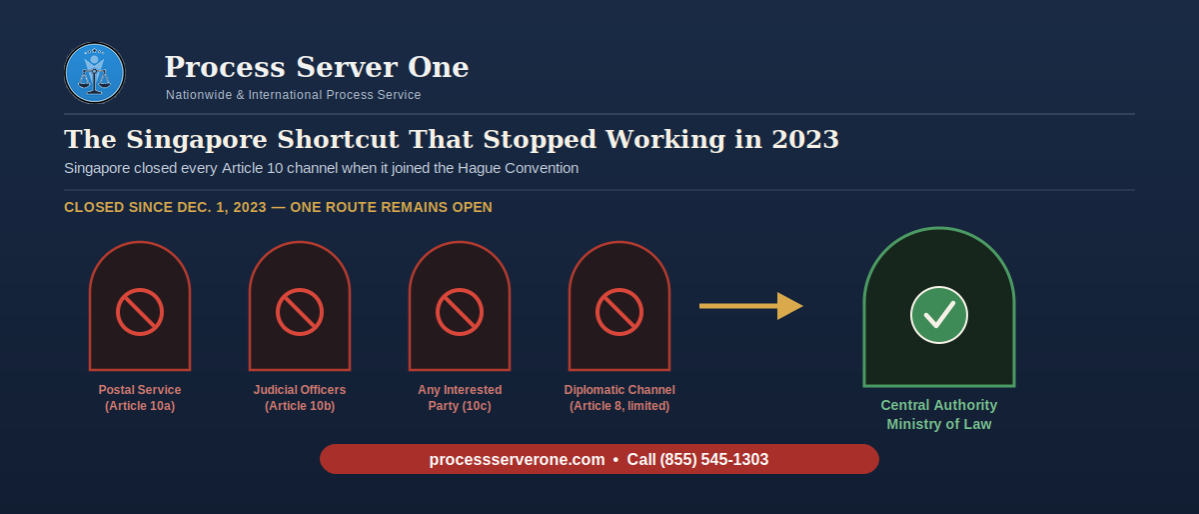
Singapore acceded to the Hague Service Convention on May 16, 2023. The convention entered into force there on December 1, 2023. Before that date, Singapore was not a party at all. Informal delivery filled that role instead.
That gap is closed now. Anyone serving documents from a Hague country into Singapore has one route left. It runs through the government, not a private server acting alone. Firms with matters pending in Singapore right now should check how service was handled. Anything filed the old way after December 2023 may need to be redone. Better to catch that now than at trial.
Why Hague Service in Singapore Got Harder, Not Easier
Most countries that join the treaty still leave a few Article 10 options open. Postal service is one common example. So is a simple courier drop. Direct delivery through local officers is another. Some countries object to one channel but not the others. That leaves at least one shortcut in place, even after joining. Singapore, by contrast, left none of that open at all. It objected to all three Article 10 channels in one single move. The change was deliberate, not an oversight.
Singapore also limited Article 8. That is the diplomatic and consular channel. That one only works now when the recipient shares the nationality of the country doing the serving. So a US plaintiff cannot lean on it for a Singaporean defendant. In effect, that door is shut too. Together, these two changes removed nearly every alternative path. Other Hague countries still allow at least one of them. Joining the treaty made Singapore harder to serve, not easier. That catches longtime litigators off guard. After all, familiarity with the old system breeds a false sense of confidence. Firms that handled Singapore matters for years under the old system have nothing familiar to fall back on now.
What Getting Hague Service in Singapore Right Actually Takes
The Ministry of Law is Singapore’s Central Authority. Every request now goes through that office. It uses the standard Hague transmission form. That form is known as USM-94 for requests coming from the United States. An attorney or a court-commissioned official has to sign it. That is the price of formality. There is no way around it.
Small errors here cause real delays. The form needs to be complete, accurate, and signed by the right person before the Ministry will act on it. A rejected filing does not just cost a resubmission. In short, it resets the clock on an already unfamiliar process. Firms used to handling their own informal delivery in Singapore often find this step unfamiliar the first few times through. In practice, though, most filings clear once the paperwork habit sets in.
The Translation Question Most Attorneys Get Wrong
English generally works for the Authority itself. Singapore has long run its courts in English, a holdover from its colonial legal history. Many filers stop their translation planning right there. That is usually a mistake.
That is not always enough, though. U.S. due process asks for documents in a language the actual defendant understands. It is not enough that the receiving country’s courts accept English. A defendant who reads Malay, Mandarin, or Tamil more comfortably may still need papers in that language. Skipping that step invites a due process challenge later. That risk sits apart from anything the treaty itself requires.
This distinction trips people up because it sits outside the treaty entirely. The Ministry of Law will process an English filing without complaint. A U.S. judge asks something different instead: did the defendant actually understand what was served? Attorneys who confirm a defendant’s language ability early avoid a fight later. Assuming English by default is the riskier habit. Better to ask than guess.
How Long the New Process Actually Takes
Nobody has a long track record to point to yet. Singapore’s Hague system only started running in December 2023. That is barely any time at all. It lacks the years of data that older Central Authorities have built up. New systems tend to run slower at first. Early estimates suggest several months from submission to a returned proof of service.
Patience pays off here. That uncertainty argues against treating this like a routine filing. A case with a tight deadline needs extra lead time built in. There is no way around that yet. This channel is still new, and it remains largely untested at scale. Even so, most firms adapt within a case or two. Filing early is the simplest way to absorb any delay. Do it well before a deadline actually bites, since the Ministry’s own backlog can be unpredictable.
How Process Server One Handles Hague Service in Singapore
Process Server One prepares Central Authority filings correctly from the outset, which matters most in a system this new. The team completes the required transmission form. It arranges translation whenever a defendant’s language calls for it. It also tracks the submission until proof of service comes back. Every step gets checked before it goes out. Nothing gets rushed out the door.
That consistency matters most in a system this young. The team handles apostille processing too, along with skip tracing when a Singapore address needs confirming. For matters that reach beyond Singapore, the same team also coordinates service across the rest of the world. That work draws on Central Authority experience built up across dozens of Hague countries. Overall, that breadth is what keeps a new system like Singapore’s from becoming a guessing game.
The Bottom Line
Hague service in Singapore no longer works the way it did before December 2023. The old habits no longer apply. Informal delivery used to fill a real gap. That gap is gone now. Singapore objected to every Article 10 alternative. Route requests through the Ministry of Law instead. Watch the translation question closely. Build extra time into the schedule too, while this channel is still finding its footing.
Need service in Singapore handled the correct way? Request Singapore process service now or call (855) 545-1303 to talk through your timeline.
FAQs
1. When did the Hague Service Convention start applying to Singapore? Singapore acceded on May 16, 2023. The convention entered into force there on December 1, 2023. Before that, Singapore was not a party at all.
2. Can informal or direct personal service still be used for Hague service in Singapore? No. Singapore objected to all three Article 10 channels. That closed off postal service and direct delivery alike. The Central Authority is now the only valid route.
3. What is Singapore’s Central Authority for Hague service? The Ministry of Law. Requests go through that office using the standard Hague transmission form. That form is USM-94 for filings originating in the United States.
4. Do documents need to be translated for service in Singapore? English usually satisfies the Authority itself. A defendant who does not read English comfortably may still need a translation. Malay, Mandarin, or Tamil can meet U.S. due process standards instead.
5. How long does the new process take? Current estimates point to several months from submission to a returned proof of service. The system is still new enough that a firm track record has not built up yet.
6. Does Process Server One handle Hague service in Singapore? Yes. The team prepares the Central Authority submission. It arranges translation when needed, and handles apostille and skip tracing work too.