Arizona subpoena costs catch many attorneys off guard. Picture a clinic that sends back 400 pages with an invoice on top. The attorney expected paper. The clinic expected payment. Nothing went wrong, though. Arizona law lets a nonparty bill the requesting side for the work. Still, the number on that bill depends on which rate sheet you trust.
This guide covers who pays, how much, and when. It also flags a rate mismatch worth checking before you budget. Treat it as background rather than legal advice. For anything specific to a case, a licensed attorney and the court’s own rules are the right resources.
Why Arizona Subpoena Costs Fall on the Requesting Side
Section 12-351 of the Arizona Revised Statutes covers civil cases where a nonparty gets a subpoena to produce documents. The party that asked for the records pays the witness’s reasonable costs. The witness has to send an itemized statement first. Standard copies run 25 cents a page. Clerical work to find and gather the records runs $25 an hour per person. Documents that need special processing cost whatever the actual reproduction costs. The Arizona Legislature publishes the full text.
Timing helps the requester. Nobody has to pay before the documents are ready, and the statute says so plainly. Reasonable here means the rates the statute sets. The witness can demand payment when the documents change hands. So the bill arrives with the box, not before it.
The Rate Mismatch Behind Arizona Subpoena Costs
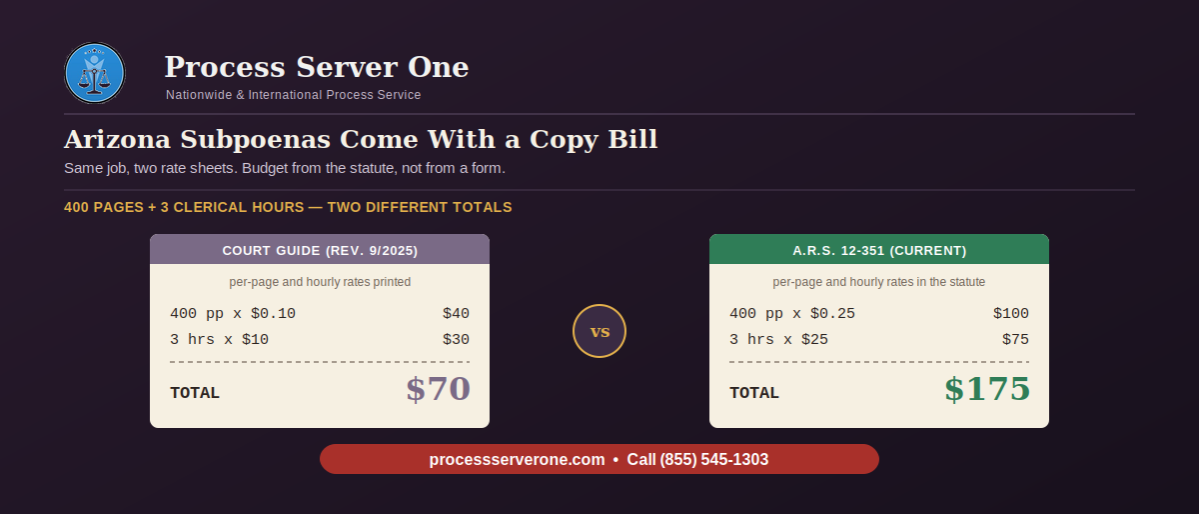
Here is the catch. The statute once set the rates at 10 cents a page and $10 an hour. A 2015 bill, S.B. 1316, raised both to 25 cents and $25. The current text on the Legislature’s site uses the higher numbers. However, at least one court guide still prints the old ones. The Maricopa County Justice Courts guide for civil document subpoenas, revised in September 2025, lists $0.10 a page and $10 an hour.
Run the 400-page clinic example both ways. At the guide’s rates, 400 pages and three clerical hours come to $70. At the statute’s rates, the same job comes to $175. That gap is easy to miss, and it can turn a routine invoice into an argument. The statute is the law, while a form is only a guide. So budget from the statute, and confirm the current text before you rely on any form.
What Changes Arizona Subpoena Costs After Service
Costs can start before the documents ever move. Suppose the requesting side withdraws the subpoena, or narrows it. The witness still gets reasonable costs for work done before notice. So tell the witness quickly, because notice stops the clock. Keep three records: the itemized statement, the date you told the witness about any change, and proof of payment. A dispute over excessive costs turns on those papers. The requester has one more tool. A party can ask the court to recover costs already paid, or to cut charges, if they were excessive.
The witness has tools of their own. A written objection is due before the compliance date or within 14 days after service, whichever comes first. For documents, an objection pauses compliance until a court orders it. It does not excuse a command to appear, though. Also, when a witness does not have to attend in person, the statute limits payment to this cost section.
What a Custodian Can Do With a Document Subpoena
Records-only subpoenas leave the custodian with choices. A custodian can deliver the documents by the deadline and skip the appearance. The records can arrive as kept in the usual course of business. They can also come sorted and labeled to match the subpoena’s categories. The custodian can also object in writing, move to quash, or demand payment at delivery. Each choice changes the calendar. So ask early what the custodian plans to do. An objection also starts a conversation. The serving party has to try in good faith to resolve it before asking a court for an order. That conversation takes days, so build it into the schedule.
The requesting side owes the witness a duty too. Whoever serves the subpoena must take reasonable steps to avoid undue burden or expense. A narrow request costs less and moves faster. Because a broad one invites objections, it often costs more in the end.
How Arizona Subpoena Costs Differ When Attendance Is Required
A witness who must attend gets different treatment. When the subpoena commands attendance, the server tenders one day’s attendance fee and mileage with the papers. Rule 45 skips that tender when a party must attend a trial or hearing. It also skips it when the subpoena comes from the state or its agencies.
Distance limits apply too. The rule keeps nonparties close to home. They have to attend only in the county where they live or do business in person. The county of service works as well, as does any spot within 40 miles of the place of service. A court order can pick another place. Trial is different, since the court can call a witness from anywhere in the state. Any nonparty who is at least 18 can serve the papers. Courts also differ on forms. The justice courts, the superior courts, and the federal courts each publish their own, so check the one for the court that issued the subpoena.
How Process Server One Helps With Arizona Subpoenas
Process Server One serves personal subpoenas and record subpoenas in all 15 Arizona counties. The company also lists subpoena preparation among its services. It describes itself as a licensed and bonded Arizona process server. Same-day, next-day, and weekend service are available for legal documents. Then a proof of service arrives by email. The custodian’s bill goes to the requesting party, so plan that budget separately. Share the subpoena type and the compliance date when you place the order.
The Arizona page covers statewide service, and the Maricopa County page covers the Phoenix area. The record subpoena page explains the records side. For a witness who must receive papers directly, see the page on personal subpoenas. The general subpoena service page covers the rest.
The Bottom Line
Arizona subpoena costs are easy to predict and easy to forget. Budget from the statute, not from a form. Narrow the request. Then tell the witness fast if plans change. Still, the most common surprise is the bill itself. In short, ask what the copies will cost before the box arrives.
Planning around Arizona subpoena costs? Request Arizona subpoena service now or call (855) 545-1303 to talk through your case.
FAQs
1. Who pays a records custodian’s copying costs in Arizona? The requesting party pays, once the witness sends an itemized statement of the costs.
2. How much can a custodian charge? The current statute allows 25 cents a page and $25 an hour per person for clerical work. Special processing costs the actual amount. Some court guides still print older rates, so check the current text.
3. When is payment due? Not before the documents are ready. The witness can demand payment at delivery.
4. How long does a witness have to object? Before the compliance date or within 14 days after service, whichever comes first.
5. What if the requesting party withdraws the subpoena? The witness still gets reasonable costs for work done before notice. That is why prompt notice matters.
6. Does Process Server One serve subpoenas in Arizona? Yes. The team serves personal and record subpoenas in all 15 counties. It also offers same-day, next-day, and weekend service for legal documents.