A Newark landlord’s attorney learned the hard way what serving court papers in New Jersey requires. He mailed a summons to a tenant who had moved out months earlier, marked the case served, and moved on with confidence. Weeks later, a judge asked the one question nobody wants to hear: where is the proof that anyone tried? Before this state accepts a mailed notice or any shortcut around it, it wants to see a real, documented attempt to hand the papers over first. Skip that step, and even a lawsuit that technically went out can come apart at the seams.
This piece walks through why courts here insist on that in-person attempt first. It covers what a “diligent inquiry” affidavit has to show, the order backup methods must follow, and a mailing rule that quietly trips up more cases than it should. Treat it as background rather than legal advice. For anything specific to your matter, the New Jersey Court Rules and a licensed attorney are the ones to ask.
Why Personal Delivery Comes First in Serving Court Papers in New Jersey
Under New Jersey Court Rule 4:4-4, the primary way to bring a defendant into a case is almost disarmingly simple. Hand that person the summons and complaint, face to face, inside the state. Every other method the rules allow is a fallback, used only once this first option has truly failed.
The logic holds up under scrutiny. A certified mail receipt can sit unopened in a stack of junk mail for weeks. A person handed papers on their own porch has a much harder time later claiming they never knew a lawsuit existed. New Jersey built its entire service system around that one clean moment of contact. The rules do not let a plaintiff step around it without a genuine reason on record.
What a Diligent-Inquiry Affidavit Actually Has to Prove
Here is where a lot of out-of-state filers stumble. You cannot try a stale address once, shrug, and drop the complaint in the mail. Before a court accepts any substituted method, Rule 4:4-4 calls for a sworn affidavit. It has to show that personal service failed despite real, diligent effort, not that it was merely inconvenient to arrange.
In practice, that means several attempts at different times of day, plus genuine work confirming where the defendant currently lives or works. A single knock at an outdated address does not come close to clearing that bar. The affidavit is where all of it gets written down, and a thin one is just what opposing counsel goes looking for. This is where a server who knows New Jersey earns the fee. They build that record attempt by attempt, rather than reconstructing it after a judge starts asking questions.
The Backup Ladder for Serving Court Papers in New Jersey
Once the diligent-inquiry paperwork is on file, New Jersey opens a specific order of alternatives, and jumping straight to the bottom rung is not allowed. First in line is personal service outside the state, delivered by mail or a public official wherever the defendant now lives. For defendants overseas, treaty rules or an appointed agent take over from there.
Only after that does the rule allow certified or registered mail to the defendant’s home, business, or registered agent. An ordinary mailing goes out at the same time. If none of that lands, a plaintiff can ask the court to approve some other method as a genuine last resort. Each rung assumes the one above it was truly out of reach. That loops right back to why that first diligent-inquiry record has to hold up.
The 60-Day Trap Hiding in the Mail Rule
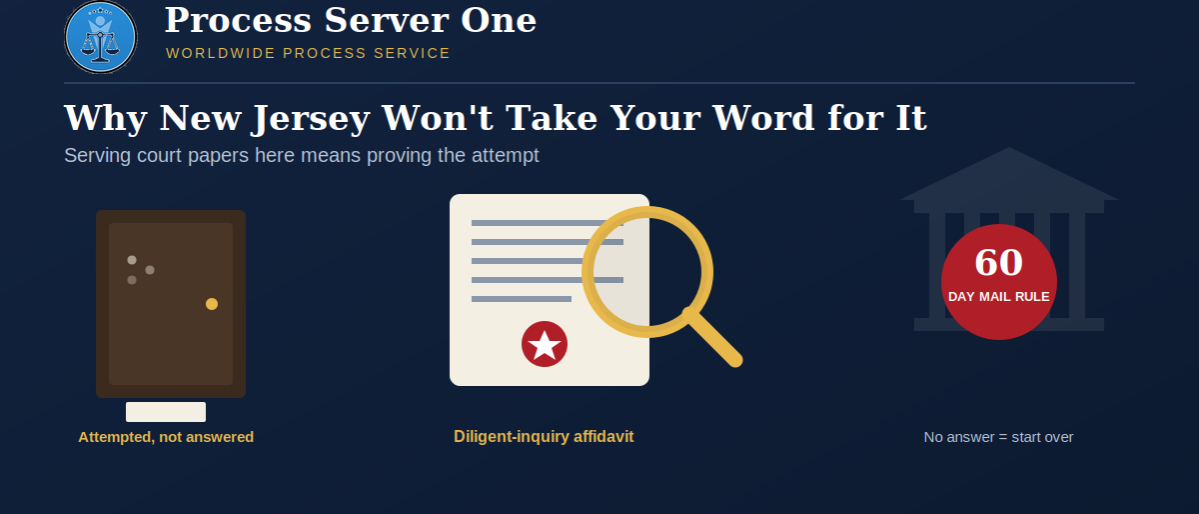
Here is the part that quietly wrecks timelines. New Jersey does allow an optional mailed notice under the primary method, but it comes with a string attached. That mailing only establishes jurisdiction if the defendant answers it.
Send the papers, hear nothing back, and it is tempting to assume the job is done. It is not. If 60 days pass with no response, the plaintiff has to start over using a properly prescribed method. That is precisely how weeks disappear and a filing deadline suddenly feels a lot closer than it did a month earlier. Treating a quiet mailbox as a finished job is one of the costliest habits in New Jersey service, and one of the most common.
Who’s Allowed to Knock, and Why a Pro Still Beats a Volunteer
New Jersey is unusually relaxed about who may physically deliver the papers. A sheriff can do it. So can a court-appointed person, an attorney or their agent, or any competent adult with no stake in the case. No state license is required for any of them.
So why does hiring a professional still matter? Because the handoff was never the hard part. The hard part is a diligent-inquiry record that holds up in front of a skeptical judge. It is the address verification that finds someone who does not want to be found, and an affidavit that survives a challenge months later. A defendant actively avoiding service turns a routine task into something closer to detective work. That is just the kind of case where skip tracing and hands-on experience earn their cost.
Where Serving Court Papers in New Jersey Usually Goes Wrong
When serving court papers in New Jersey goes wrong, it is rarely one dramatic error. A handful of small mistakes show up again and again. Some filers jump straight to mail or a substituted method without ever building a genuine diligent-inquiry record. Others treat an unanswered mailing as the finish line, only to learn weeks later that it was not.
Then there is the affidavit that lists one half-hearted attempt and hopes no one looks closely. That is just the kind of gap opposing counsel is trained to find. And sometimes no one confirmed the defendant’s current address before the attempts even started, which dooms the effort before it begins. A verified address, a real paper trail, and an affidavit that can survive scrutiny are what separate service that holds from service that gets thrown out.
How Process Server One Approaches Serving Court Papers in New Jersey
Process Server One runs New Jersey cases the way the rules expect them to run. Personal service comes first, attempted at sensible hours and documented as it happens rather than reconstructed from memory once a deadline is looming. When personal service genuinely cannot be made, the team builds the diligent-inquiry affidavit properly. Then it works down the backup ladder in the right order, not the fastest one.
Every attempt gets logged for a clean return, and attorneys get real status updates instead of silence. For New Jersey cases that reach beyond state lines, the team coordinates service across the country and around the world. That matters when a defendant has relocated or the filing itself originates somewhere else. Familiarity with the diligent-inquiry standard and the 60-day mail trap is just what keeps a case from stalling over a technicality no one saw coming.
The Bottom Line
New Jersey does not ask you to take a plaintiff’s word that a lawsuit was served. Serving court papers in New Jersey means proving the attempt, not just claiming it. Try in person first, and document every attempt as though it might end up in front of a judge. Only step down the backup ladder once personal service has truly run out of road. Get that record right from the start, and the rest of the case can move the way it is supposed to.
Need New Jersey service handled by people who know just what the record has to show? Request a New Jersey process server now or call (855) 545-1303 to talk through your matter.
FAQs
1. What is the primary method of service in New Jersey? Personal, in-person delivery of the summons and complaint within the state comes first under Rule 4:4-4. Every other method is a fallback, used only once that has truly failed.
2. What does a diligent-inquiry affidavit need to show? A sworn statement that, despite real effort, personal service could not be made. Courts generally require it before allowing mail or any other substituted method.
3. Does a mailed copy count as service on its own? Not automatically. An optional mailing only establishes jurisdiction if the defendant responds. No answer within 60 days means starting over with a properly prescribed method.
4. Who is legally allowed to serve process in New Jersey? A sheriff, a court-appointed person, an attorney or their agent, or any competent adult with no stake in the case. New Jersey does not require a state license to serve.
5. If no license is required, why hire a professional at all? Because the handoff is rarely the hard part. The diligent inquiry, the address verification, and an affidavit that survives a challenge are where cases get won or lost.
6. Does Process Server One handle defendants outside New Jersey? Yes. The team coordinates service across state lines and internationally, which helps whenever a defendant has moved or a case crosses borders.