
A paralegal researching Hague service in Georgia in early 2021 would have found a clear, if frustrating, answer. There was no formal method. Letters Rogatory were the only real option. Search that same question today, and the answer has quietly flipped. Georgia joined the Hague Service Convention. The old advice, still repeated in plenty of places, is now out of date. Attorneys who have not caught up are still planning around a rule that stopped applying years ago.
This piece covers what changed and how the new process works. It also covers where the outdated advice still causes real problems. Treat it as background rather than legal advice. For anything specific to a matter, start with the Hague Conference’s own status table. Then talk to a licensed attorney.
The Day Hague Service in Georgia Became the Rule
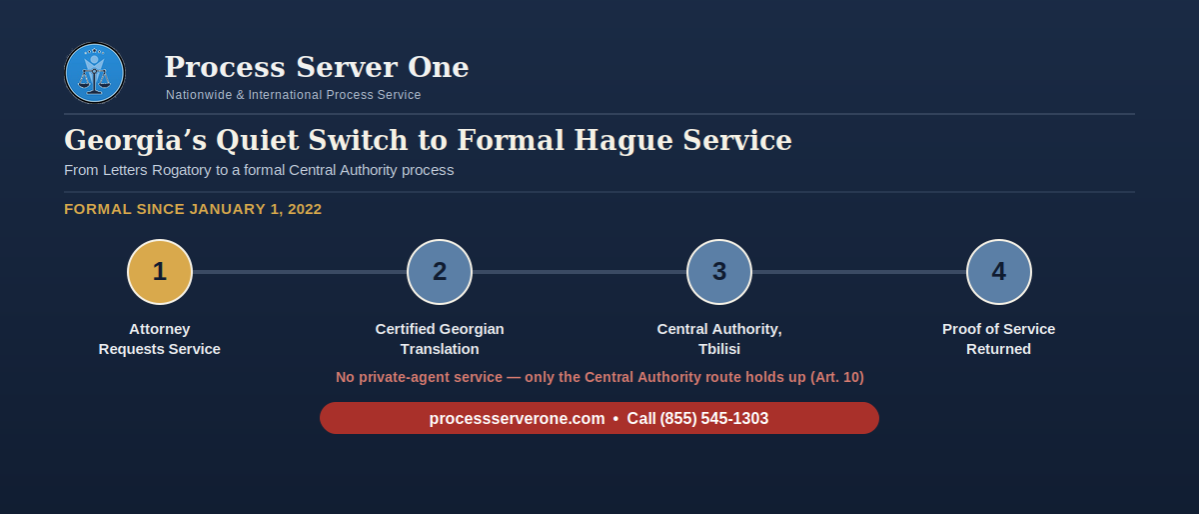
Georgia acceded to the Hague Service Convention on May 31, 2021. The convention entered into force there on January 1, 2022. Before that date, Georgia sat outside the treaty. Letters Rogatory were the only formal route into its courts.
That single date matters more than it looks. Letters Rogatory can take a year or longer. They route through diplomatic channels with no fixed timeline at all. The Hague Convention’s Central Authority route is not fast either. But it runs on a clear, structured process. Anyone still quoting the pre-2022 rule is steering a client toward the slower path. They may not even realize a faster, formal one now exists.
How Georgia’s Central Authority Actually Handles a Request
Georgia named its Ministry of Justice as the Central Authority under Article 5. The actual work happens in Tbilisi. It runs through the Ministry’s International Relations and Legal Cooperation Department. A requester fills out a standard Hague transmission form. A qualified official then signs it. That form, along with the documents themselves, goes to the Ministry.
Every document needs a Georgian translation, no matter how well the defendant reads English. That step is not a courtesy. It is how the Central Authority processes the request at all. From submission to a completed return, the timeline often runs several months. This route rewards early filing far more than a rushed one.
Why Hague Service in Georgia Skips the Private Process Server
Some Hague countries let a private agent walk up and hand over the papers directly. Article 10 of the convention allows that. Georgia is not one of them. It formally objects to the private-agent and direct-service channels under Article 10. That closes off the shortcut some attorneys expect from other Hague jurisdictions.
The Central Authority route is the one that holds up in court instead. A postal option exists on paper, but Georgia’s own guidance treats it as risky in practice. Skipping the formal process to save time might feel efficient. It is exactly the kind of shortcut that creates a flawed return later.
The Old “No Formal Method” Advice Is Now Wrong
Plenty of legal guides still describe Georgia the way it was before 2022. So do internal firm memos. So do a few service providers. That advice was accurate once. It no longer is. Treating Georgia as unavailable for formal service can cost a case real time. It defaults straight to Letters Rogatory when a faster channel already exists.
The stakes here are not just theoretical. Georgian courts have already handled cases like this one. Service happened outside the Central Authority channel entirely. One court accepted that shortcut at first. A higher court later rejected it. A defective service finding late in a case is expensive. It costs far more than the extra weeks a proper Hague filing takes up front.
What Hague Service in Georgia Means for Translation and Timelines
Georgian translation is mandatory for the formal channel. That step belongs at the very start of the timeline. It does not belong in the middle, after a first attempt stalls. Waiting to translate until a deadline is close is a common mistake. It is one of the easiest ways this process gets delayed further.
Realistic planning matters more than optimism here. A multi-month window from submission to a returned proof of service is normal. It is not a sign that something has gone wrong. Cases that build that timeline into their scheduling from the outset avoid a scramble later. That scramble usually starts when someone assumed Georgia would move at a domestic pace.
How Process Server One Handles Hague Service in Georgia
Process Server One handles the full Central Authority route for Georgia. The team prepares the required Hague transmission paperwork. It also arranges certified Georgian translation before anything goes to Tbilisi. That groundwork is what keeps a filing from bouncing back over a technical defect.
The team also sets clear expectations up front. A multi-month timeline is normal for this channel, and surprises help no one. Every step gets recorded for a clean return. For matters that extend beyond Georgia, the team also handles service across the rest of the world. That work draws on decades of experience with international service of process. It covers Hague and non-Hague countries alike.
The Bottom Line
Hague service in Georgia is not the exception it used to be. Since January 1, 2022, it has been the formal rule. It routes through the Ministry of Justice in Tbilisi. That is not the slower Letters Rogatory process many still assume is the only option. Budget for Georgian translation from day one. Expect a multi-month timeline. Treat the Central Authority channel as the reliable route it actually is.
Need service handled correctly in Georgia? Request international process service now or call (855) 545-1303 to talk through your timeline.
FAQs
1. When did the Hague Service Convention start applying to Georgia? Georgia acceded on May 31, 2021, and the convention entered into force there on January 1, 2022. Before that date, Letters Rogatory were the only formal option.
2. Can a private process server deliver documents directly in Georgia? No. Georgia objects to the private-agent and direct-service channels under Article 10. That leaves the Central Authority route as the one that holds up in court.
3. Does Georgian translation matter for formal service? Yes. The formal Hague channel requires a Georgian translation. That holds no matter how well the defendant reads English.
4. How long does Hague service in Georgia typically take? Often several months from submission to a returned proof of service. Building that window into case scheduling avoids unnecessary pressure later.
5. Is Letters Rogatory still an option for Georgia? It technically still exists. The catch is speed. It runs slower than the Hague Central Authority route now that the convention applies. It no longer needs to be the default choice.
6. Does Process Server One handle Hague filings for Georgia? Yes. The team prepares the required paperwork and arranges certified Georgian translation. It also handles the Central Authority submission from start to finish.