
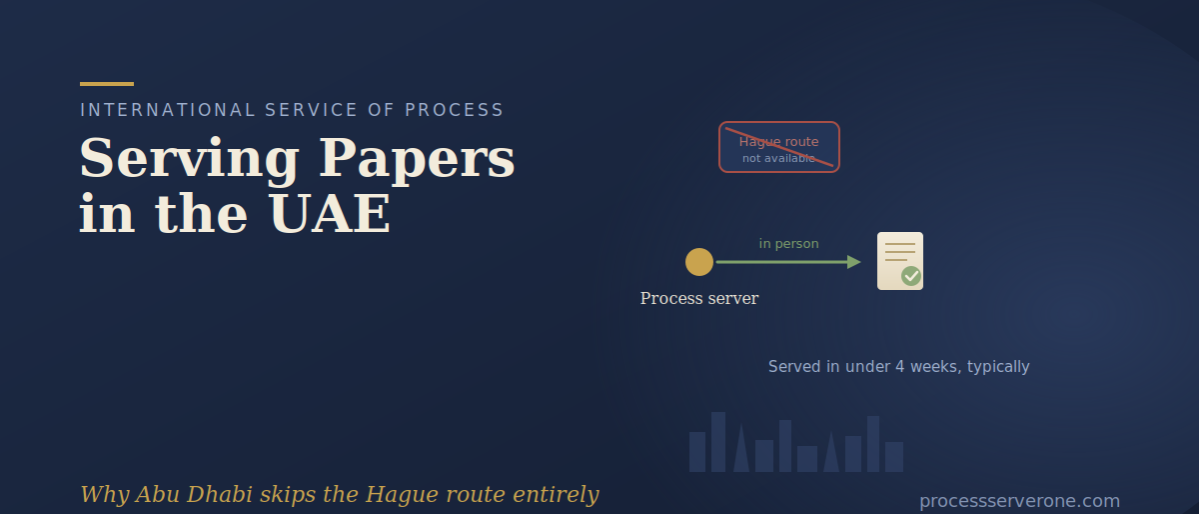
Serving papers in the UAE catches many attorneys off guard. You expect the familiar Hague Convention route. The one that works for Germany, Japan, or France. Then you learn the United Arab Emirates is not a Hague member at all. There is no Central Authority to route your request through, and no formal treaty method to follow. The U.S. State Department’s judicial assistance guidance is the go-to reference for non-Hague countries like the UAE.
That sounds like a problem. In practice, it can be an advantage. Because the UAE has no formal service channel, a server delivers papers informally, in person. That route often moves far faster than the treaty method. This guide covers why Abu Dhabi works this way and how informal service actually happens. It also shows what attorneys should know before a case crosses into the Emirates.
Why Serving Papers in the UAE Skips the Hague Route
The Hague Service Convention only helps in countries that signed it. The UAE never did. So the treaty machinery simply does not apply. No Central Authority, no model forms, no certificate of service.
That leaves two real paths. One is a Letter Rogatory. That is a slow, formal diplomatic request that winds through governments and courts. The other is informal service. Here, a private process server hand-delivers the documents straight to the person or business. For most matters in Abu Dhabi, the informal route is the practical one. It skips the diplomatic backlog entirely. In fact, it looks a lot like how service works in the United States or the United Kingdom.
How Serving Papers in the UAE Actually Works
Informal service is simpler than it sounds. A local process server first locates the individual or business. Then the server delivers the documents in person at the correct address.
That in-person delivery is the whole method. There is no clerk to file with and no treaty form to complete. And there is no months-long wait for a foreign authority to act. A skilled server confirms the address first, makes the delivery, and records exactly what happened for your file. Most informal assignments wrap up in under four weeks. That is a fraction of the time a formal diplomatic request can take. For a case on a deadline, that speed matters. It is often the difference between moving forward and stalling.
Why Serving Papers in the UAE Still Takes Care
Faster does not mean effortless. Abu Dhabi has its own rhythms. Local customs and traditions can create delays at any point in the year.
Timing is one factor. Business hours, holidays, and cultural practices all shape when you can actually reach someone. Location is another. A defendant in a gated compound or behind private security is harder to reach than one at an open office. Address accuracy matters enormously too. An outdated address in an unfamiliar country wastes time you may not have. And the person may simply not want to be found. That is where professional experience earns its place. So the informal route is faster. Still, it rewards knowing the ground.
What About Translations and Court Orders
Serving papers in the UAE brings a couple more details to weigh. Translation is usually recommended rather than required for informal service, though it becomes important when a defendant might later claim they did not understand the documents.
The U.S. State Department suggests translating documents even when it is not strictly required. After all, a clearly understood document is harder to challenge. The UAE also uses the apostille process to authenticate documents. The appropriate embassy or ministry handles that step. And when a defendant cannot be found at all, service by publication may be an option. Still, the odds of an enforceable judgment rise sharply with a court order first.
Common Challenges When Serving Papers in the UAE
Even a fast route has friction. The biggest trap is assuming Abu Dhabi works like a Hague country. Chase a Central Authority that does not exist, and you waste weeks.
Locating the defendant is a frequent hurdle. That is true when the address on file is stale or incomplete. Distance and unfamiliarity add cost and coordination. A domestic serve never needs that. Low-price scam services are a real risk here, too. Some outfits offer a single attempt, with no plan for a bad address and no refund. And enforceability depends on choosing the right method for your goal. That is a decision worth making carefully, not by default. None of this is beyond reach. It simply rewards working with a server who handles the Emirates regularly.
How Process Server One Helps
This is where a seasoned international team pays off. Process Server One provides international service of process in Abu Dhabi and across the UAE. Its servers cover both metropolitan and rural areas.
The team confirms the address and runs skip tracing when the location is unclear. Then a server hand-delivers the documents in person under the informal method. They keep you updated through an online portal and arrange translation when a case calls for it. On request, they can also file your Proof of Service with the court. With more than three decades of international experience and coverage in 80-plus countries, they move fast. They know how to handle an Emirates assignment quickly and document it properly.
None of this controls local customs or a defendant’s schedule. Those are outside anyone’s hands. But it does mean the service is handled correctly, by people who serve in the region and know its quirks.
Why Attorneys Choose Process Server One
Attorneys, law firms, and businesses turn to Process Server One for Emirates service that holds up. Not just papers sent abroad and hoped over. The value is in speed plus accuracy, an in-person service done right and documented for your file.
That work rests on more than 30 years of international experience and a global network of licensed servers. It adds in-house translation help and real familiarity with how the UAE handles service. When a case depends on reaching someone in Abu Dhabi, that experience is what keeps it moving.
Have a defendant in Abu Dhabi or anywhere in the UAE? Do not lose weeks hunting for a Hague route that does not exist. Submit your international service request now, or call the team at (855) 545-1303. You will talk it through with a licensed international process server. The sooner an informal service begins, the sooner your case moves forward.
Conclusion
Serving papers in the UAE runs on a different track than most international service. There is no Hague Convention here. No Central Authority, and no formal treaty method. Instead, a private server hand-delivers the documents in person. That often saves months over the diplomatic route. Knowing that upfront helps. And working with a team that serves the Emirates regularly turns a confusing cross-border assignment into a straightforward one.
FAQs
1. Is the UAE part of the Hague Service Convention? No. The United Arab Emirates is not a member, so there is no Central Authority or formal treaty method for service.
2. How are papers served in Abu Dhabi then? Usually through informal service. A private process server hand-delivers the documents in person to the individual or business.
3. Is informal service faster than the formal route? Generally yes. Most informal assignments finish in under four weeks, while a formal diplomatic request can take many months.
4. Do documents need to be translated? Translation is recommended rather than required for informal service, but it helps prevent a defendant from later claiming they did not understand the papers.
5. What if I do not have the defendant’s address? A skip trace can often locate a current address before an attempt, which is faster than guessing from an outdated record.
6. Can papers be served by publication in the UAE? It may be an option when a defendant cannot be found, though an enforceable judgment is far more likely if a court order is obtained first.