
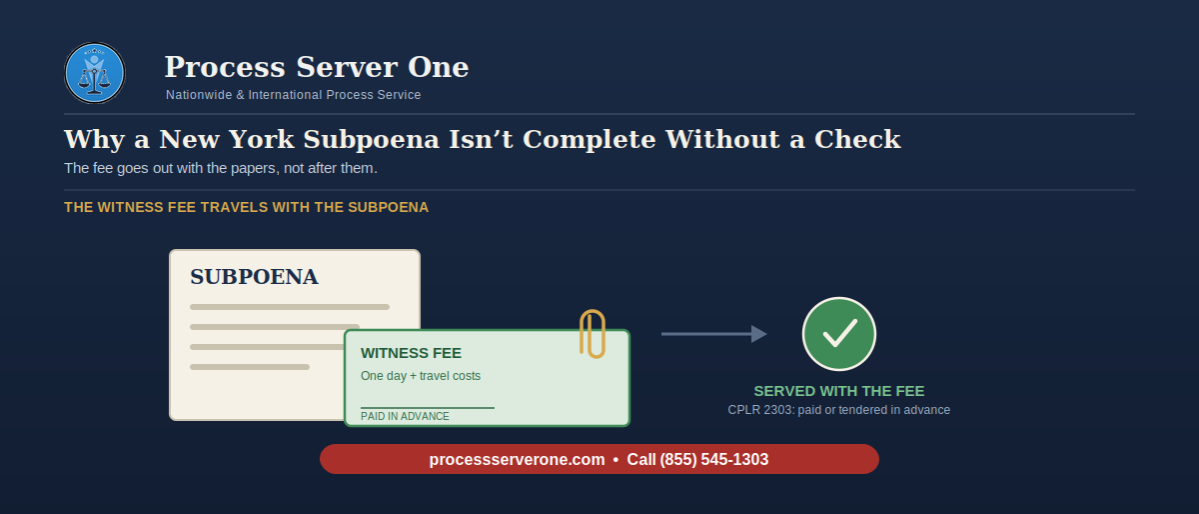
Nobody bills the New York witness fee later. Instead, it goes out with the subpoena itself. Picture a clean in-hand delivery in Brooklyn. The witness takes the papers, but nobody mentions a check. Weeks pass. The witness never shows up, and a motion to quash lands instead. Still, nothing was wrong with the delivery. The fee was simply missing. In short, a small step cost the whole subpoena.
This guide covers what the law requires and what the amounts are. It also shows how the rule plays out with different service methods. Treat it as background rather than legal advice. For anything specific to a case, a licensed attorney and the court’s own instructions are the right resources.
Why the New York Witness Fee Travels With the Subpoena
CPLR 2303 is short, and its message is blunt. The server must pay or offer travel costs and one day’s fee in advance. In fact, the word that matters is advance. Guidance from the state courts says the same thing in plain language. Payment comes due the moment the server delivers the subpoena. It is not a favor, and it is not a reimbursement. The New York witness fee is also part of what makes the subpoena work. That is a real difference from some other states, where the fee follows only if the witness asks. So the server cannot wait for a request.
What the New York Witness Fee Actually Covers
CPLR 8001 sets the numbers. The attendance fee is $15 a day. Mileage runs 23 cents a mile. Count it from where the server reaches the witness to the place of attendance and back. However, there is no mileage for travel wholly within a city. A witness served in Manhattan and called to a courthouse in the Bronx therefore gets no mileage. A non-party witness at a pretrial deposition gets an extra $3 for each day. Amounts like these can change. Check the current statute before cutting a check. So do the math first. Otherwise, a server who has to compute mileage in a hallway will make mistakes.
When the New York Witness Fee Meets Substituted Service
New York serves a subpoena the same way it serves a summons. That means in-hand delivery first. If that fails, the rules allow leaving the papers with a suitable person and mailing a copy. After earlier attempts fail, they also allow affixing the papers to a door and mailing a copy. Service finishes when the server completes both steps. So where does the check go? The statute says the server must pay or tender the fee in advance. It does not say how that works when the papers land with a third party. A careful practitioner, therefore, does not leave it to chance. The payment goes in the same packet, with the amount stated. As a result, the tender is on the record. Local court practice varies, so confirm what the assigned court expects.
Who Can Serve, and What to File
In New York City Civil Court, the instructions are clear about who can serve. It must be an adult who is not a party and not a police officer. The server then completes an affidavit of service. A notary must sign it. The same instructions ask for service at least five days before the date. City and state agencies and public libraries are the exception, though, with a 24-hour minimum. The same instructions limit service to New York City, Nassau County, and Westchester County unless a judge allows more. Those are Civil Court rules. Other courts may differ, so check the one handling the case.
The Copy Every Party Should Receive
Records subpoenas add a second duty. CPLR 2303 says a copy of the subpoena duces tecum must also go to each party who has appeared. That copy has to arrive promptly after service on the witness. It also has to arrive before the witness hands over any records. In other words, opposing counsel must see the request before the documents change hands. Attorneys can issue these subpoenas themselves, without a court order, under CPLR 2302. Because of that speed, the copy is easy to forget. So add it to the checklist. If you skip it, the other side can challenge both the subpoena and what it turned up. Patient clinical records under the Mental Hygiene Law are the exception, and those need court authorization.
What Happens When Someone Misses the New York Witness Fee
The rules treat an unpaid witness differently. The New York City Civil Court says someone must pay the fee a reasonable time before the date. Its instructions also say a witness who gets nothing need not appear. Practitioners often call such a subpoena voidable, and a motion to quash is the usual route. Then a routine delivery turns into a hearing. It also eats the calendar. Because the first delivery failed, a rushed re-service means a fresh fee and a fresh delivery. Meanwhile, the original date passes. In short, a missed New York witness fee costs far more than the fee itself.
Parties Are Different
Not every trial subpoena needs in-hand delivery, though. CPLR 2303-a lets a trial subpoena for a party go to the party’s attorney of record. The same goes for someone within the party’s control. Delivery follows the rule on serving papers on an attorney. This helps when the witness is the opposing party. That rule does not apply, however, to an independent witness. A bystander still needs the full process, fee included.
How Process Server One Helps With New York Subpoenas
Process Server One serves subpoenas across all 62 New York counties, including the five boroughs. The service list on the New York page includes record subpoenas, personal subpoenas, and subpoena preparation. The company offers same-day, next-day, and weekend service for legal documents in the state. Then a proof of service arrives by email. The company is a licensed and bonded New York process service company. Because the fee must be in hand at delivery, settle who supplies it when you place the order. Then the server can go out ready. The general subpoena service page covers trial, deposition, and record subpoenas in more detail.
The Bottom Line
The New York witness fee is part of the delivery, not an afterthought. Calculate it first. Send it with the papers. Then follow the service method the court expects, and copy every party on a records subpoena. Still, most failed subpoenas do not fail on the address. They fail on a missing check. In short, a few minutes of planning protects the whole calendar.
Need a subpoena served in New York with the fee handled right? Request New York subpoena service now or call (855) 545-1303 to talk through your case.
FAQs
1. How much is the New York witness fee? CPLR 8001 sets $15 a day and 23 cents a mile, round trip. However, no mileage applies within a city. Non-party deposition witnesses get $3 more each day. Because amounts can change, check the current statute.
2. When does the witness fee come due? In advance. The statute says the server must pay or tender it. The courts say the fee comes due when the server delivers the subpoena.
3. Can you serve a subpoena by mail in New York? It follows the same rules as a summons. That means in-hand delivery. It can also mean leaving the papers with a suitable person and mailing a copy. Affixing the papers to a door and mailing a copy is the third option. Service finishes when the server completes both steps.
4. Who can serve a subpoena in New York City Civil Court? An adult who is not a party and not a police officer. The server completes a notarized affidavit of service.
5. Do opposing parties get a copy of a records subpoena? Yes. A copy of a subpoena duces tecum must go to each party who has appeared. It has to arrive promptly after service on the witness and before the witness produces records.
6. Does Process Server One serve subpoenas in New York? Yes. The team serves subpoenas in all 62 counties, including record and personal subpoenas. It also offers same-day, next-day, and weekend service.