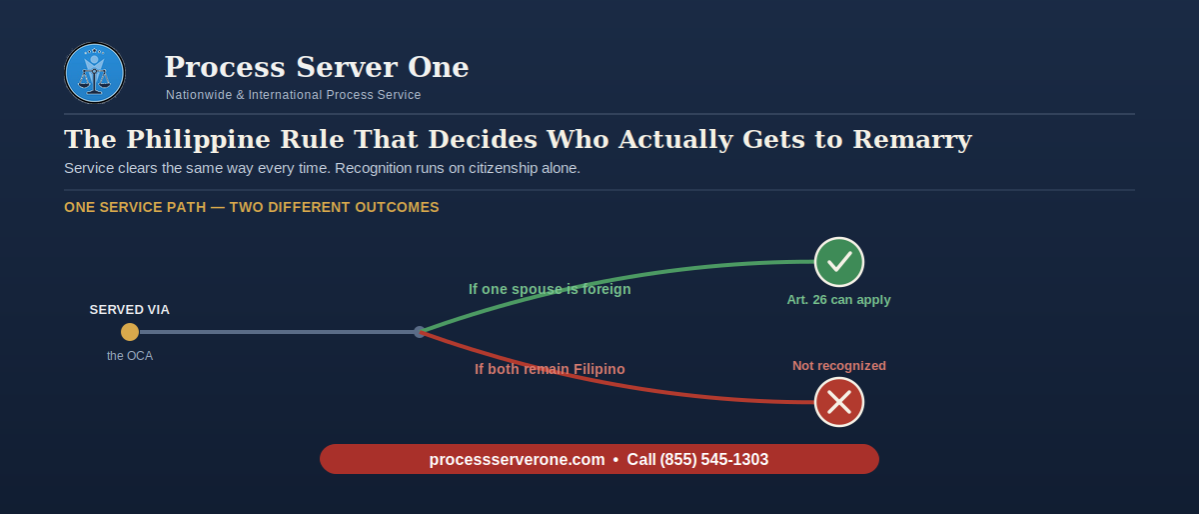
Divorce papers in the Philippines go through the Office of the Court Administrator. That office handles them the same as any other civil case under the treaty. One attorney assumed that was the end of the story. His client’s Manila-based spouse got served without a hitch. In fact, the paperwork cleared fast. Nothing about the service itself raised a flag. Still, the real question sat elsewhere, out of view. The U.S. court finalized the divorce months later, clean and on schedule. Then the attorney learned something that had nothing to do with service at all. The surprise came later, from a different office instead. His client’s spouse was still legally married under Philippine law. Neither side had ever held a foreign passport. That single fact changed everything. Nothing else about the case mattered as much.
This piece breaks down how service actually works here, and why it never was the hard part. It also covers the citizenship rule that decides what a foreign divorce is worth once the Philippine side has it. Treat it as background rather than legal advice. For anything specific to a case, a licensed attorney and the Hague Service Convention are the right resources.
Why Divorce Papers in the Philippines Move Like Any Other Hague Case
Family law sits well inside the Hague Service Convention‘s reach. The treaty covers civil matters broadly, and divorce counts as one. Nothing in the treaty carves family cases out. The Philippines joined in 2020. The Office of the Court Administrator, or OCA, now handles each incoming request. Mail service does not work here. The Philippines declined that option under Article 10. So does a private server acting alone, without the formal channel behind it. Instead, everything routes through the Central Authority. Translation into English or Filipino may be needed, depending on the recipient. Still, plan for a few months from filing to a completed return. Some requests move faster than that. None of that differs much from a contract dispute or a debt case. In fact, the paperwork looks almost identical either way.
The One Rule That Decides Whether Divorce Papers in the Philippines Count
Here is where family law breaks from the pattern. The Philippines does not recognize divorce between two Filipino citizens, full stop. That rule comes from the nationality principle in the Civil Code. Marital status follows citizenship, not residence. Even so, it does not bend for a validly served foreign judgment either. Article 26 of the Family Code carves out one exception. It applies only when one spouse was a foreign national at the time of the divorce. Call it a mixed marriage, and the rule starts to work in the Filipino spouse’s favor. Call it a marriage between two Filipino citizens, and a completed U.S. divorce changes nothing back home. Proper service was never the obstacle in either case. After all, the citizenship question was always the real fork in the road.
Why It Rarely Matters Who Actually Filed
Attorneys used to assume the foreign spouse had to initiate the case. That assumption was wrong. A 2018 Philippine Supreme Court ruling settled it for good. In Republic v. Manalo, a Filipino citizen filed for her own divorce abroad, against her Japanese husband. She won it herself, start to finish. Even so, the Court still let Article 26 apply. What mattered was the result, not who asked for it first. A valid foreign divorce existed. One spouse held foreign citizenship when it was granted. That combination alone was enough. In the end, filing first changes nothing on its own. The ruling closed off a common, costly misreading of the statute.
What Divorce Papers in the Philippines Still Leave Unfinished
Even a qualifying case is not done once the Philippine side is served and the foreign court rules. Recognition in the Philippines is never automatic, mixed marriage or not. The Filipino spouse still has to petition a Philippine court directly. That court reviews the foreign decree, and the law behind it, on its own timeline. Only after that ruling does the civil registry update the record. Then, and only then, can the Filipino spouse actually remarry. Skip that step, and a perfectly valid foreign divorce just sits there. It does nothing back home, no matter how clean the paperwork was.
When the Citizenship Timeline Quietly Changes the Outcome
Citizenship status at the time of the divorce is what counts, not status at the wedding. A spouse who naturalizes abroad before the divorce is granted satisfies Article 26 on their own. That holds true even if both were Filipino citizens when they married. In other words, timing, not the wedding date, is what the law checks. Get that timeline wrong, and a case built on the wrong assumption wastes real time and money. Confirm citizenship early, well before anyone finalizes a petition on either side. A quick records check beats a rejected recognition case months down the line. Again, it rarely takes long to confirm. In short, it is a small step that saves a large headache later.
How Process Server One Handles Divorce Papers in the Philippines
Process Server One routes each Philippine request through the OCA. That is exactly what the treaty requires. The team arranges translation whenever the recipient’s language calls for it. Every submission gets tracked until a signed return comes back. Simply put, nothing sits waiting without a check-in. The team also handles apostille work, along with skip tracing whenever a Manila or provincial address needs confirming first. For cases that reach beyond the Philippines, the same team coordinates service across the rest of the world. That work draws on Central Authority experience built up across dozens of Hague countries. Nothing about Philippine cases gets treated as an afterthought.
The Bottom Line
Divorce papers in the Philippines serve cleanly through the same channel as any other civil case. Service was never where these cases went wrong. Recognition is the real fork in the road, and it runs on citizenship alone. Confirm, first, who held what passport when the divorce was granted. Then plan for the separate Philippine court petition that recognition still requires. In practice, skipping that step is the mistake that costs the most time. It is an easy step to miss.
Need divorce papers served in the Philippines the right way? Request Philippine process service now or call (855) 545-1303 to talk through your case.
FAQs
1. Can divorce papers be served in the Philippines through the Hague Service Convention? Yes. Family law falls within the treaty’s civil matters scope, and the OCA handles each formal request.
2. Does a completed U.S. divorce count in the Philippines right away? Only if one spouse held foreign citizenship when the divorce was granted. Between two Filipino citizens, Philippine law does not recognize it at all.
3. Does it matter which spouse filed for the foreign divorce? No. Republic v. Manalo (2018) confirmed that a Filipino spouse can file for and win the divorce abroad on her own. She still qualified, since the other spouse was a foreign national.
4. Is a foreign divorce recognized right away once that requirement is met? No. The Filipino spouse still has to petition a Philippine court to recognize the decree. Only then does the civil registry update, and only then does remarriage become possible.
5. Can documents be served by mail in the Philippines? No. The Philippines declined Article 10 mail service, so requests go through the formal Central Authority channel instead.
6. Does Process Server One handle divorce papers in the Philippines? Yes. The team routes requests through the OCA. It arranges translation when needed, and handles apostille and skip tracing work.